
Index
What defines a small used car dealer in software terms
The three most time-consuming tasks the software must solve
What a small used car dealer doesn't need in its software
Which features to look at before signing up
How much software for small used car dealers costs
Dealcar for small used car dealers
Frequently asked questions
What defines a small used car dealer in software terms
A small used car dealer is one that sells between 5 and 25 cars a month, usually with one or two employees besides the owner, and runs the business with limited time and money.
In that context, the most important criterion for choosing software isn't how many features it has, but how many of those features you'll actually use from the first month. A system with 40 modules of which you use 5 isn't good software for your business: it's an expensive system that, on top of that, makes you feel you're wasting your time.
The right software for a small used car dealer solves the three or four problems that take up the most time each week well, can be learned in days and doesn't need a technical team to maintain it.
The three most time-consuming tasks the software must solve
The first is publishing stock on portals. If you publish manually on coches.net, AutoScout24 and Wallapop, each new car takes between 30 and 60 minutes filling in listings, uploading photos and checking everything is correct. With a multi-posting system, that time drops to under 10 minutes per vehicle. For a dealer listing 15 cars a month, that's between 6 and 8 hours a month recovered on this point alone.
Read how stock multi-posting on portals from Dealcar works.
The second is lead management. When contacts arrive from several channels at once (a portal, WhatsApp, the website form), without a centralised system leads start getting lost along the way. A basic CRM that groups all contacts in a single dashboard and reminds you when to follow up can make the difference between closing 12 sales a month or 15.
Read also how to automate lead follow-up in a dealership.
The third is invoicing under REBU. If your invoicing program doesn't handle REBU natively, you're calculating per-vehicle margin manually and building the record book by hand. That work can take between 3 and 5 hours a month that should be automated.
Check what a REBU billing software for dealerships must comply with.
What a small used car dealer doesn't need in its software
A complex sales pipeline with multiple stages and per-salesperson reports is useful when you have a team of three or more sellers. For a business where the owner handles most sales, that complexity is noise.
An advanced reporting module with customisable dashboards makes sense when the business generates enough data for that analysis to drive decisions. At a dealer selling 10 cars a month, the owner already knows by heart what's working and what isn't.
OEM system integrations, multi-site management and accounting consolidation across several companies are features for groups and franchised dealerships. If your business operates from a single point of sale with a single company, you don't need them, and paying for them makes the software more expensive without adding value.
Which features to look at before signing up
The first is that the software handles REBU natively: a correct invoice without a VAT breakdown and with the legal notice, automatic margin calculation from the vehicle file and generation of the record book. If these three things aren't native, you'll have to build the process manually.
Check what the REBU registry book must include and how to organise it.
The second is multi-posting on portals with automatic updates: when you change the price or sell the car, that change must propagate to all portals with a single click, not portal by portal.
The third is the learning curve. Request a 30-minute demo and simulate publishing a car, recording a lead and generating the invoice for a sale. If in that time you haven't been able to complete all three steps on your own, the system is too complex for your business.
The fourth is support in Spanish with a reasonable response time. For a small used car dealer without its own technical team, having someone resolve a question the same day can be the difference between closing a sale or losing it.
How much software for small used car dealers costs
The usual ranges in the Spanish market in 2026 for used-car-dealer-specific software go from 80 euros a month for basic solutions (mainly stock management and publishing on portals) up to 150 or 200 euros a month for platforms that include CRM, REBU invoicing, website and an integrated agency.
Below 80 euros a month, the tools available are usually general accounting solutions (Holded, Contasimple) that aren't designed for the sector and don't handle REBU natively. The saving on the fee is offset by the time you lose manually managing what the software doesn't do.
Read also why Holded, Sage, and A3 do not manage REBU well in a car dealership.
Above 200 euros a month, you get into platforms aimed at higher volumes, with features that a dealer selling fewer than 25 cars a month will rarely use profitably.
Check the complete comparison of software for car dealerships in Spain.
Dealcar for small used car dealers
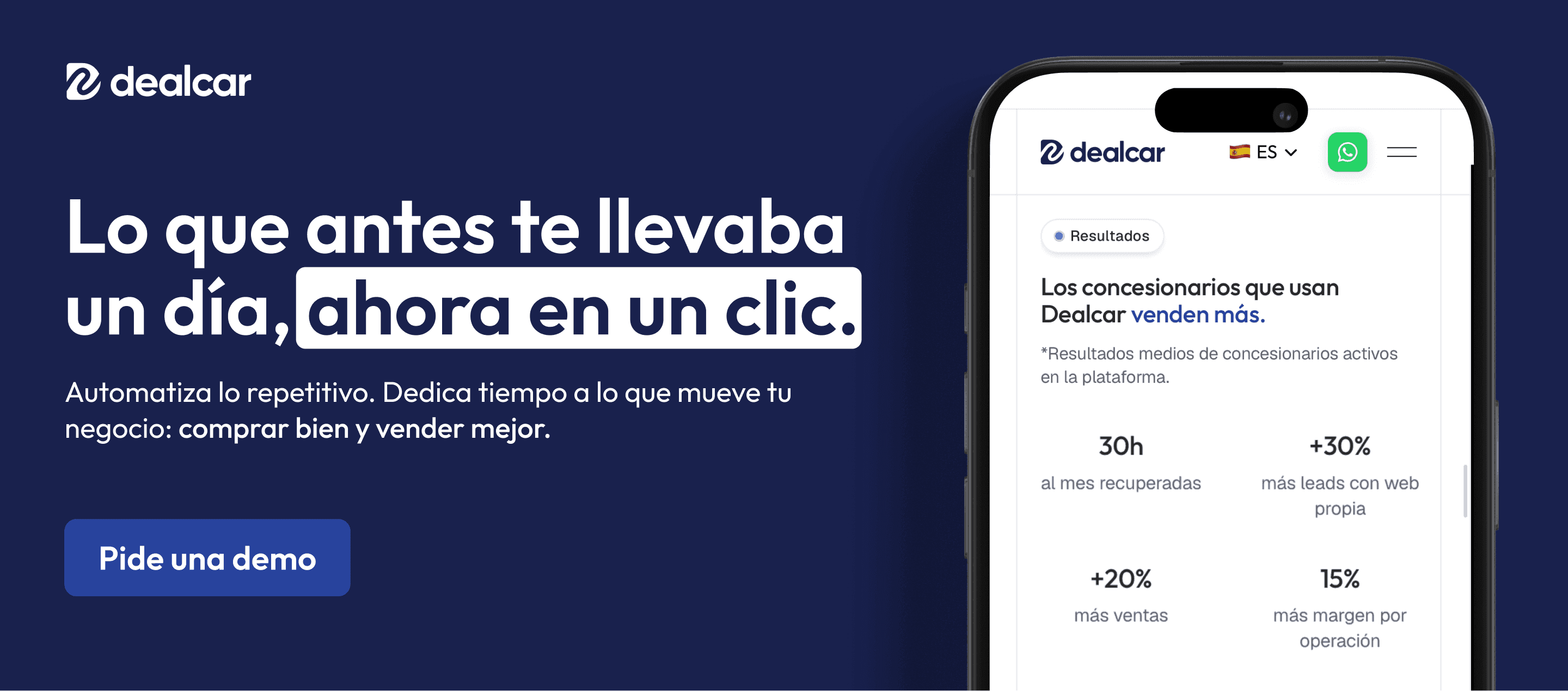
Dealcar is designed specifically for the independent used car dealer, including lower-volume ones who want to operate professionally without paying for features they won't use.
The entry plan includes stock management with a file per vehicle, multi-posting on portals, lead CRM, Verifactu-certified REBU invoicing and a professional website. Onboarding is completed in less than a week and requires no technical knowledge.
To see which plan fits the size of your business, visit our website or request a demo at dealcar.io.
Frequently asked questions
Can software for a small used car dealer grow with me if the business scales?
Yes, if it's designed for it. Dealcar works from 5 cars a month up to 150 without changing platform. The plan adjusts to volume with no need to migrate to another system.
Do I need a separate invoicing program if I already have used car dealer software?
No, if the software includes native REBU invoicing and is certified for Verifactu. Having two separate systems for stock management and invoicing duplicates the work and increases the risk of errors in the REBU record book.
What happens to my historical data if I switch from Excel or another program?
Migrating active stock and contacts is included in Dealcar's onboarding. The history of previous transactions doesn't need to be migrated: it stays in the previous system for reference and Dealcar starts from the activation date.