

Contents
What is a DMS and what is its purpose in a dealership
What features must an automotive DMS cover
Difference between a DMS, a CRM and an ERP
Real problems of managing a dealership without a DMS
How to evaluate a DMS before purchasing it
What to look at beyond functionalities
Frequently Asked Questions
What is a DMS and what is its purpose in a dealership
DMS stands for Dealer Management System, which translates as a management system for dealerships. It is the software that centralises the entire operations of a vehicle sales outlet or dealership: from when a car enters stock until it is delivered to the final customer, including invoicing, documentation, taxation and after-sales follow-up.
The term comes from the high-volume vehicle distribution sector, where manufacturers required their official dealers to have approved systems to manage sales, spare parts and workshops. Over time, the concept has spread to the independent and used car sales segment, where needs are different but the logic is the same: to have the entire business in one single place instead of spreading it across Excel, physical folders, the administrative agency and WhatsApp.
For a used vehicle professional, the DMS is the system of record for everything: what cars they have, at what price they bought them, what condition they are in, what documentation they have, when they are sold and how each transaction is invoiced. Without this centralised record, the business relies on the owner's memory or the availability of the administrative agency.
What features must an automotive DMS cover
Not all DMSs are the same. A generic business management software can cover invoicing and accounting, but it does not understand the specific logic of vehicle sales. These are the functions that a DMS designed for the automotive sector must cover:
Stock management. Quick registration of vehicles with all their data (licence plate, chassis, km, equipment, status), tracking of time in stock per unit and visibility of the estimated margin per car. Stock is the primary asset of a car sales business: if you do not have control over it, you do not have control over the business.
Digital file per vehicle. Each car must have its digital file with the associated documentation: registration certificate, technical specification sheet, MOT (ITV), DGT report, purchase and sales invoices, photos, reservation contract and sales agreement. Looking for a piece of paper in a folder when the customer is standing in front of you is not an option in 2025.
Invoicing adapted to REBU (Special Scheme for Second-Hand Goods) and general scheme. This is the key difference between an automotive DMS and any other invoicing software. The system must know which scheme applies to each operation according to the origin of the vehicle, correctly calculate the taxable base under REBU (margin divided by 1.21, not margin multiplied by 0.21), generate the invoice with the mandatory mention and keep the REBU registry book updated. Generic software does not do this automatically. To understand the details of when each scheme applies, you can consult the guide on when to invoice with VAT and when to apply REBU.
Standardised contracts and documentation. Generation of sales contracts, reservation contracts and purchase documents from private sellers directly from the vehicle profile, without having to fill in templates manually or depend on the agency for each transaction.
Consultation of DGT and CARFAX reports. A well-integrated DMS allows you to consult the DGT report of any vehicle before buying or selling it, without leaving the platform. Verifying charges, seizures, MOT (ITV) and administrative status is part of the workflow, not an additional task.
Multi-posting on portals. Possibility to publish stock on Coches.net, Wallapop, AutoScout24, Milanuncios and other portals from a single point, without duplicating work. Every hour spent publishing a car manually is time that the car is not generating visibility.
Warranty tracking. Registration of active warranties per vehicle and customer, with expiry alerts. A warranty claim without supporting documentation can cost more than the repair itself.
Difference between a DMS, a CRM and an ERP
The three terms are often confused because all three are business management software, but they have different focuses.
An ERP (Enterprise Resource Planning) is an integrated business management system that covers accounting, production, human resources, purchasing and sales. It is designed for companies with complex processes and multiple departments. For a used car sales business of 5-20 people, it is oversized and expensive.
A CRM (Customer Relationship Management) focuses on managing customers and sales opportunities: lead tracking, contact history, sales pipeline. It is useful for dealerships with large sales teams, but it does not manage stock or invoicing.
A DMS combines elements of both but from the specific perspective of a vehicle sales business. It puts the vehicle at the centre (not the customer or financial processes) and builds the entire operation around it. In a small or medium-sized dealership, the DMS is the only system you need.
Some DMSs include CRM functionalities (customer tracking, leads, communication) as part of the same product. If the one you are evaluating integrates this, you can do without additional tools.
Also read how to choose the best software for car dealerships in Spain.
Real problems of managing a dealership without a DMS
The starting point for many car dealers is Excel plus an external administrative agency. It works up to a point, but it has costs that are not always perceived as such.
The first is time. Registering a car manually, filling in contracts by hand, sending documents by email to the agency and waiting for a response can consume between 30 and 90 minutes per operation. In a business that moves 15-20 cars a month, that is between 7 and 30 hours per month in administrative management alone.
The second is tax error. Calculating REBU manually operation by operation, without a system that verifies the formula, generates errors that the Spanish Tax Agency detects. A poorly calculated VAT settlement over several quarters can generate a debt with interest that far exceeds the cost of any software. The most common errors when applying REBU almost always originate in manual processes without verification.
The third is lack of visibility. Without a centralised system, answering questions like "how long has this car been in stock?", "what is the average margin of this month's transactions?" or "which cars have their MOT expiring soon?" requires searching in several places or is simply not possible. This lack of data makes purchase and pricing decisions slower and less precise.
The fourth is dependency on people. If the owner is the only one who knows where everything is, the business cannot run without them. A DMS makes the information available to anyone in the team at any time.
Also check out how to automate a car dealership.
How to evaluate a DMS before purchasing it
Before committing to any software, it is advisable to ask the right questions during the demo or trial period.
Is it designed for used car sales or is it an adaptation of another sector? The difference is in the details: if the system handles REBU natively, if it has specific fields for vehicle data (chassis, km, MOT, DGT environmental badge) or if you have to adapt it yourself.
How long does it take to register a vehicle? If it exceeds 5-7 minutes, the system is not well-optimised for the real flow of an active car dealer.
Does it generate the REBU registry book automatically? If you have to export data and build it yourself, it is not an automotive DMS, it is a generic software with car templates.
Can you consult the DGT report from the vehicle profile? Integration with the DGT to check charges, MOT and administrative status before each purchase is a time-saving and trouble-preventing feature. Having to leave the platform to make this query is an unnecessary friction.
Does it allow posting to portals directly? Integrated multi-posting saves between 20 and 45 minutes per car in managing advertisements. If the system does not include it, you will have to keep doing it manually or purchase another tool. To understand how posting time affects stock turnover, you can review the article on how to reduce used vehicle turnaround time.
How is support? In the automotive sector, problems do not always occur during office hours. Knowing if support is by phone, chat or only by ticket, and what the usual response time is, is relevant information before purchasing.
Also read the best portals to sell cars in Spain.
What to look at beyond functionalities
Two DMSs with similar features can have very different impacts on daily life depending on factors that do not appear on the feature sheet.
The speed of adoption by the team is one of them. A highly complete but difficult-to-use system takes months to implement effectively, and during that time the business continues to run as before. Real usability, tested with day-to-day tasks, matters as much as paper features.
The pricing model is another. Some DMSs charge per number of vehicles in stock, others per number of users, others per operations carried out. Depending on the volume of the business, the pricing structure can make the same software cost twice as much as the alternative. Ask for a simulation with your real volume before deciding.
The frequency of updates also matters. Tax regulations change, portal formats are updated, DGT modifies its systems. A DMS that is not updated regularly ends up being a problem instead of a solution. Asking how many relevant updates they have published in the last year is an easy way to evaluate the product's pace of development.
For a broader view of how digitisation affects the results of a used vehicle dealership, you can consult the article on how to scale your used car dealership.
More than 750 used car dealers already use Dealcar to manage their daily operations
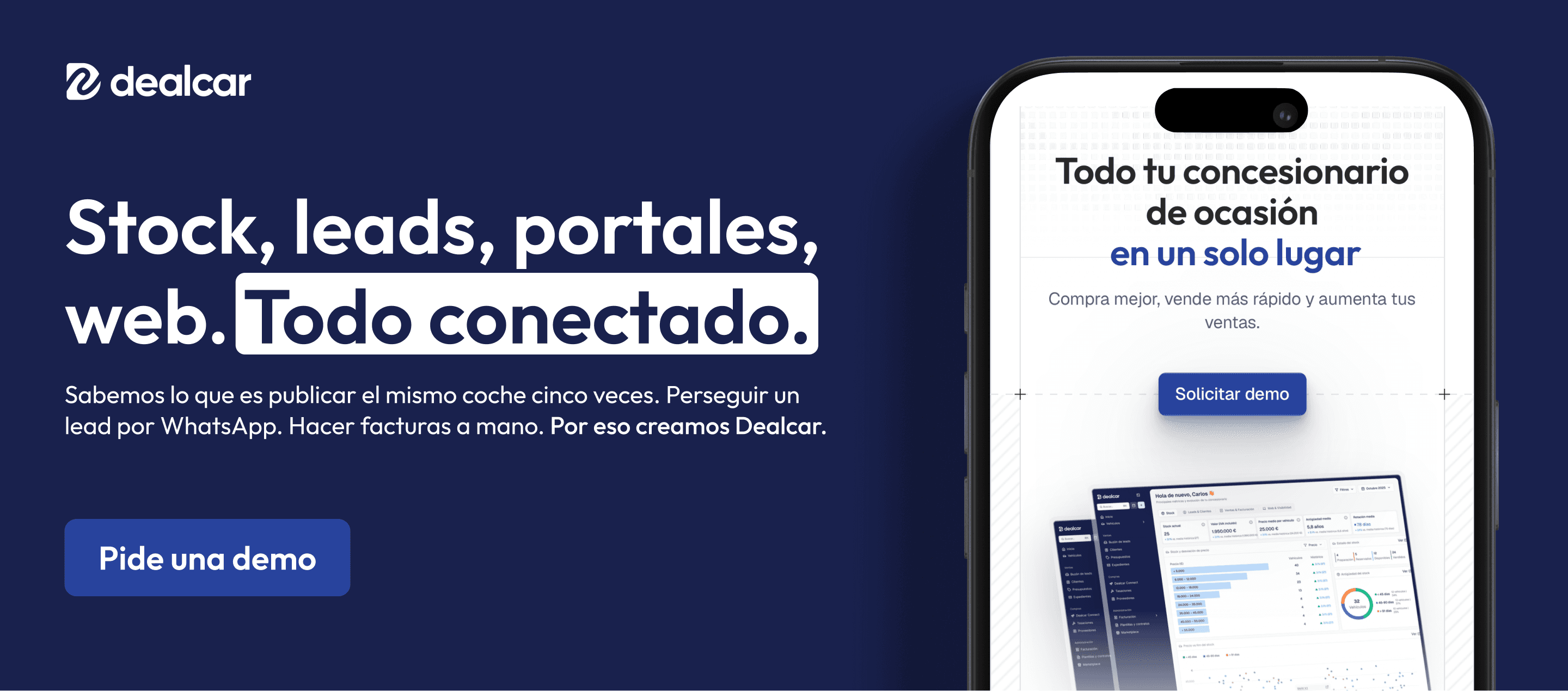
Dealcar is the DMS designed specifically for used car sales and independent dealerships of pre-owned vehicles in Spain. Stock management, digital files per vehicle, invoicing with automatic REBU, registry book, consultation of DGT and CARFAX reports, contracts and multi-posting on portals: all in a single platform, accessible from your mobile phone or computer.
Discover Dealcar's DMS at dealcar.io/dms-software-concesionario or you can schedule a free demo at dealcar.io.
Frequently Asked Questions
Is a DMS only for large dealerships?
No. Most current DMSs are designed to be accessible for dealers with 5-10 cars per month. In fact, the impact on time and errors is proportionally greater in small businesses, where one person carries out several roles at the same time and every poorly utilised hour is more noticeable.
How much does an automotive DMS cost?
The range is wide: from basic solutions for €50-80/month to complete platforms for €200-400/month, depending on the features, the number of users and the pricing model. To evaluate the real cost, you have to compare it with the time you currently dedicate to administrative management and the cost of the tax errors it avoids.
Can a DMS replace the administrative agency?
For day-to-day operational tasks (invoicing, REBU registry book, contracts, VAT returns), a well-configured DMS significantly reduces dependency on the agency. For annual accounting closing, tax returns or complex tax procedures, the tax advisor is still necessary, but with much less prior work on their part because the information is already organized.
How long does it take to implement a DMS?
It depends on the software and the volume of historical data to migrate. To start operating with new cars entering the stock from scratch, most modern DMSs allow you to be operational in a couple of days. Migrating the full history of previous transactions may take longer, but it is not essential to get started.
Does the DMS integrate with car sales portals?
Automotive-specialised DMSs include integration with the main portals (Coches.net, AutoScout24, Wallapop, Milanuncios). The integration allows you to publish and update advertisements directly from the vehicle profile in the DMS, without logging into each portal separately.
Contents
What is a DMS and what is its purpose in a dealership
What features must an automotive DMS cover
Difference between a DMS, a CRM and an ERP
Real problems of managing a dealership without a DMS
How to evaluate a DMS before purchasing it
What to look at beyond functionalities
Frequently Asked Questions
What is a DMS and what is its purpose in a dealership
DMS stands for Dealer Management System, which translates as a management system for dealerships. It is the software that centralises the entire operations of a vehicle sales outlet or dealership: from when a car enters stock until it is delivered to the final customer, including invoicing, documentation, taxation and after-sales follow-up.
The term comes from the high-volume vehicle distribution sector, where manufacturers required their official dealers to have approved systems to manage sales, spare parts and workshops. Over time, the concept has spread to the independent and used car sales segment, where needs are different but the logic is the same: to have the entire business in one single place instead of spreading it across Excel, physical folders, the administrative agency and WhatsApp.
For a used vehicle professional, the DMS is the system of record for everything: what cars they have, at what price they bought them, what condition they are in, what documentation they have, when they are sold and how each transaction is invoiced. Without this centralised record, the business relies on the owner's memory or the availability of the administrative agency.
What features must an automotive DMS cover
Not all DMSs are the same. A generic business management software can cover invoicing and accounting, but it does not understand the specific logic of vehicle sales. These are the functions that a DMS designed for the automotive sector must cover:
Stock management. Quick registration of vehicles with all their data (licence plate, chassis, km, equipment, status), tracking of time in stock per unit and visibility of the estimated margin per car. Stock is the primary asset of a car sales business: if you do not have control over it, you do not have control over the business.
Digital file per vehicle. Each car must have its digital file with the associated documentation: registration certificate, technical specification sheet, MOT (ITV), DGT report, purchase and sales invoices, photos, reservation contract and sales agreement. Looking for a piece of paper in a folder when the customer is standing in front of you is not an option in 2025.
Invoicing adapted to REBU (Special Scheme for Second-Hand Goods) and general scheme. This is the key difference between an automotive DMS and any other invoicing software. The system must know which scheme applies to each operation according to the origin of the vehicle, correctly calculate the taxable base under REBU (margin divided by 1.21, not margin multiplied by 0.21), generate the invoice with the mandatory mention and keep the REBU registry book updated. Generic software does not do this automatically. To understand the details of when each scheme applies, you can consult the guide on when to invoice with VAT and when to apply REBU.
Standardised contracts and documentation. Generation of sales contracts, reservation contracts and purchase documents from private sellers directly from the vehicle profile, without having to fill in templates manually or depend on the agency for each transaction.
Consultation of DGT and CARFAX reports. A well-integrated DMS allows you to consult the DGT report of any vehicle before buying or selling it, without leaving the platform. Verifying charges, seizures, MOT (ITV) and administrative status is part of the workflow, not an additional task.
Multi-posting on portals. Possibility to publish stock on Coches.net, Wallapop, AutoScout24, Milanuncios and other portals from a single point, without duplicating work. Every hour spent publishing a car manually is time that the car is not generating visibility.
Warranty tracking. Registration of active warranties per vehicle and customer, with expiry alerts. A warranty claim without supporting documentation can cost more than the repair itself.
Difference between a DMS, a CRM and an ERP
The three terms are often confused because all three are business management software, but they have different focuses.
An ERP (Enterprise Resource Planning) is an integrated business management system that covers accounting, production, human resources, purchasing and sales. It is designed for companies with complex processes and multiple departments. For a used car sales business of 5-20 people, it is oversized and expensive.
A CRM (Customer Relationship Management) focuses on managing customers and sales opportunities: lead tracking, contact history, sales pipeline. It is useful for dealerships with large sales teams, but it does not manage stock or invoicing.
A DMS combines elements of both but from the specific perspective of a vehicle sales business. It puts the vehicle at the centre (not the customer or financial processes) and builds the entire operation around it. In a small or medium-sized dealership, the DMS is the only system you need.
Some DMSs include CRM functionalities (customer tracking, leads, communication) as part of the same product. If the one you are evaluating integrates this, you can do without additional tools.
Also read how to choose the best software for car dealerships in Spain.
Real problems of managing a dealership without a DMS
The starting point for many car dealers is Excel plus an external administrative agency. It works up to a point, but it has costs that are not always perceived as such.
The first is time. Registering a car manually, filling in contracts by hand, sending documents by email to the agency and waiting for a response can consume between 30 and 90 minutes per operation. In a business that moves 15-20 cars a month, that is between 7 and 30 hours per month in administrative management alone.
The second is tax error. Calculating REBU manually operation by operation, without a system that verifies the formula, generates errors that the Spanish Tax Agency detects. A poorly calculated VAT settlement over several quarters can generate a debt with interest that far exceeds the cost of any software. The most common errors when applying REBU almost always originate in manual processes without verification.
The third is lack of visibility. Without a centralised system, answering questions like "how long has this car been in stock?", "what is the average margin of this month's transactions?" or "which cars have their MOT expiring soon?" requires searching in several places or is simply not possible. This lack of data makes purchase and pricing decisions slower and less precise.
The fourth is dependency on people. If the owner is the only one who knows where everything is, the business cannot run without them. A DMS makes the information available to anyone in the team at any time.
Also check out how to automate a car dealership.
How to evaluate a DMS before purchasing it
Before committing to any software, it is advisable to ask the right questions during the demo or trial period.
Is it designed for used car sales or is it an adaptation of another sector? The difference is in the details: if the system handles REBU natively, if it has specific fields for vehicle data (chassis, km, MOT, DGT environmental badge) or if you have to adapt it yourself.
How long does it take to register a vehicle? If it exceeds 5-7 minutes, the system is not well-optimised for the real flow of an active car dealer.
Does it generate the REBU registry book automatically? If you have to export data and build it yourself, it is not an automotive DMS, it is a generic software with car templates.
Can you consult the DGT report from the vehicle profile? Integration with the DGT to check charges, MOT and administrative status before each purchase is a time-saving and trouble-preventing feature. Having to leave the platform to make this query is an unnecessary friction.
Does it allow posting to portals directly? Integrated multi-posting saves between 20 and 45 minutes per car in managing advertisements. If the system does not include it, you will have to keep doing it manually or purchase another tool. To understand how posting time affects stock turnover, you can review the article on how to reduce used vehicle turnaround time.
How is support? In the automotive sector, problems do not always occur during office hours. Knowing if support is by phone, chat or only by ticket, and what the usual response time is, is relevant information before purchasing.
Also read the best portals to sell cars in Spain.
What to look at beyond functionalities
Two DMSs with similar features can have very different impacts on daily life depending on factors that do not appear on the feature sheet.
The speed of adoption by the team is one of them. A highly complete but difficult-to-use system takes months to implement effectively, and during that time the business continues to run as before. Real usability, tested with day-to-day tasks, matters as much as paper features.
The pricing model is another. Some DMSs charge per number of vehicles in stock, others per number of users, others per operations carried out. Depending on the volume of the business, the pricing structure can make the same software cost twice as much as the alternative. Ask for a simulation with your real volume before deciding.
The frequency of updates also matters. Tax regulations change, portal formats are updated, DGT modifies its systems. A DMS that is not updated regularly ends up being a problem instead of a solution. Asking how many relevant updates they have published in the last year is an easy way to evaluate the product's pace of development.
For a broader view of how digitisation affects the results of a used vehicle dealership, you can consult the article on how to scale your used car dealership.
More than 750 used car dealers already use Dealcar to manage their daily operations
Dealcar is the DMS designed specifically for used car sales and independent dealerships of pre-owned vehicles in Spain. Stock management, digital files per vehicle, invoicing with automatic REBU, registry book, consultation of DGT and CARFAX reports, contracts and multi-posting on portals: all in a single platform, accessible from your mobile phone or computer.
Discover Dealcar's DMS at dealcar.io/dms-software-concesionario or you can schedule a free demo at dealcar.io.
Frequently Asked Questions
Is a DMS only for large dealerships?
No. Most current DMSs are designed to be accessible for dealers with 5-10 cars per month. In fact, the impact on time and errors is proportionally greater in small businesses, where one person carries out several roles at the same time and every poorly utilised hour is more noticeable.
How much does an automotive DMS cost?
The range is wide: from basic solutions for €50-80/month to complete platforms for €200-400/month, depending on the features, the number of users and the pricing model. To evaluate the real cost, you have to compare it with the time you currently dedicate to administrative management and the cost of the tax errors it avoids.
Can a DMS replace the administrative agency?
For day-to-day operational tasks (invoicing, REBU registry book, contracts, VAT returns), a well-configured DMS significantly reduces dependency on the agency. For annual accounting closing, tax returns or complex tax procedures, the tax advisor is still necessary, but with much less prior work on their part because the information is already organized.
How long does it take to implement a DMS?
It depends on the software and the volume of historical data to migrate. To start operating with new cars entering the stock from scratch, most modern DMSs allow you to be operational in a couple of days. Migrating the full history of previous transactions may take longer, but it is not essential to get started.
Does the DMS integrate with car sales portals?
Automotive-specialised DMSs include integration with the main portals (Coches.net, AutoScout24, Wallapop, Milanuncios). The integration allows you to publish and update advertisements directly from the vehicle profile in the DMS, without logging into each portal separately.


