Introduction
If you're starting or scaling your used-car buying and selling business, one of the most important decisions is knowing where to source the vehicles. It's not enough to find cheap cars: you need good stock, with margin, reliable and with paperwork in order.
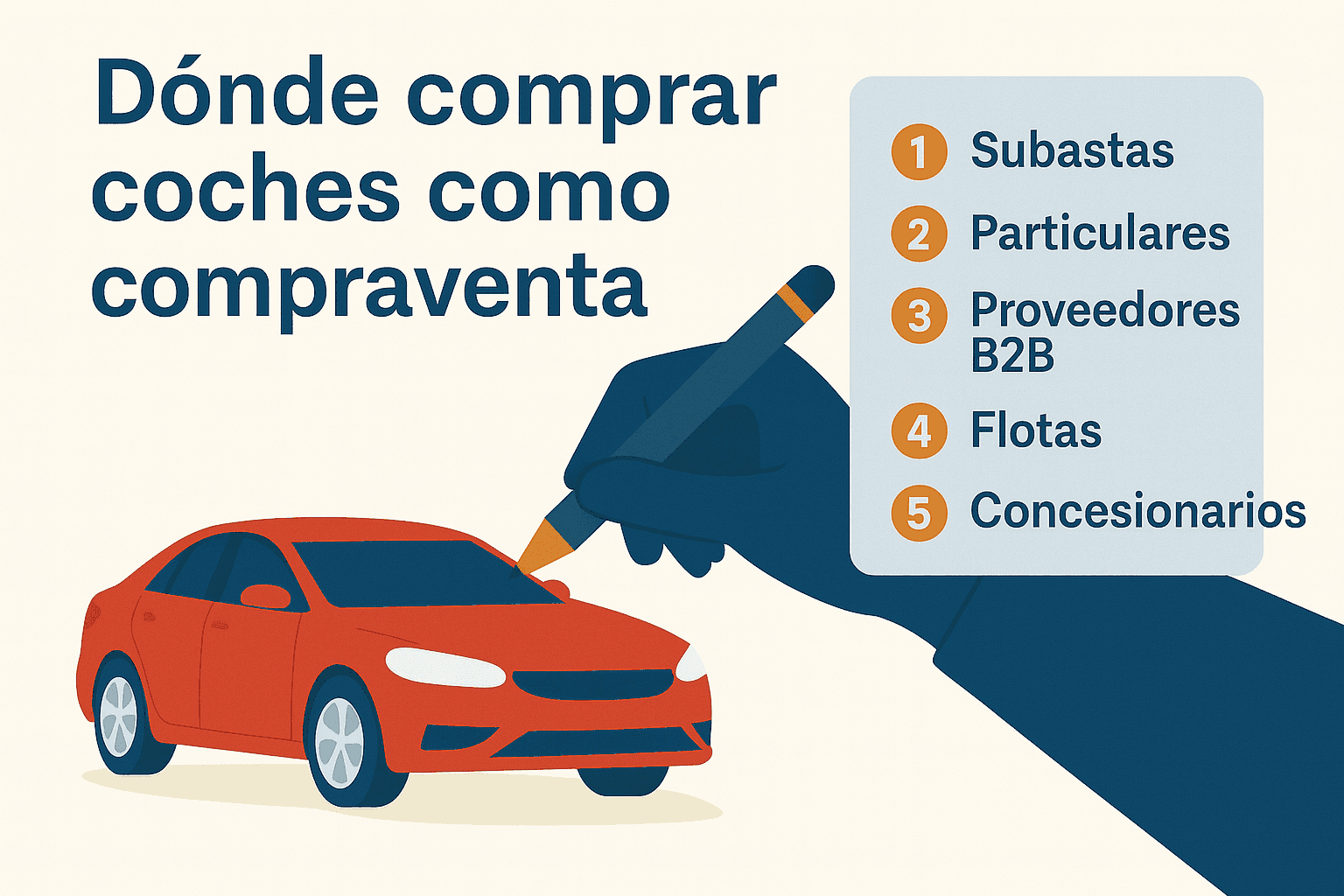
In this article we review the five channels most used by industry professionals. We'll look at their advantages, risks and tips for getting the most out of them according to your volume and strategy.
1. Vehicle auctions
How do they work?
Platforms like BCA, Autorola or Copart run auctions, both in person and online, aimed exclusively at professionals.
Pros
Very competitive purchase prices.
Access to large lots and variety.
Speed if you know how to bid well.
Cons
No test drive.
High competition and pressure.
Fees and additional costs.
Dealcar tip: Set your budget before bidding and don't get carried away by the adrenaline. Use filters and check the vehicle history.
2. Buying from private sellers
What does it involve?
Looking for opportunities on portals like Wallapop, Milanuncios, Facebook Marketplace or through personal referrals.
Pros
Higher commercial margin.
Greater negotiation capacity.
Cons
High time investment.
Risk of fraud or hidden encumbrances.
Dealcar tip: Never buy without seeing the paperwork or test-driving the car. Always carry out legal and mechanical checks.
3. Wholesalers and B2B suppliers
What do they offer?
Companies like Autoselect, CarGarantie or CarsOnTheWeb sell used vehicles only to professionals, with pre-checks.
Pros
Inspected vehicles.
Paperwork in order and streamlined processes.
Cons
Lower margin per unit.
Less flexibility to choose stock.
Dealcar tip: A good option if you want volume without after-sales complications. Perfect for quick turnover.
4. Leasing and fleets
How does it work?
Leasing companies such as LeasePlan, ALD Automotive or Northgate regularly renew their fleets and sell their used vehicles.
Pros
Complete history and official servicing.
Purchase in homogeneous batches.
Cons
Medium-high mileage.
Less varied or less exciting models.
Dealcar tip: Go for well-maintained units even if they have more miles. Reliable and steady for practical customers.
5. Dealerships and part exchanges
What does it involve?
Many dealerships take used cars in part exchange and look to sell them to other professionals. You can also buy from other car dealers.
Pros
Inspected vehicles.
Direct professional treatment.
Cons
Tighter margin.
Lower availability of units.
Dealcar tip: Build partnerships with dealerships. If you give them trust and speed, they'll think of you as the first option.
Conclusion: Diversify and build your network
There is no single perfect channel. The car dealers who make the most money combine several sources according to customer type, turnover and target margin.
Analyse, diversify and build relationships with suppliers. That is the basis for always having good, competitive and profitable stock.
Would you like Dealcar to help you find the best stock opportunities?
Try our Car Finder Agent and save hours of searching. 💻🚗
👉 Request a demo or write to us on WhatsApp for more information.
Frequently Asked Questions (FAQ)
Do I need a licence to buy cars as a professional?
Yes. You must be registered as self-employed or a company with the correct business category, declare your transactions and apply the correct tax regime (for example, REBU).
Which is the best channel to start with?
Many start with private sellers because of the margin, but if you prefer security and less paperwork, wholesalers or fleets are the better option.
Can you make money buying at auctions?
Yes, but it requires experience. It is not recommended if you're starting without training or tools.
Is it legal to buy cars abroad?
Yes, but it involves more paperwork: import, MOT, homologation, fees and taxes. It's viable if you know the process.
Introduction
If you're starting or scaling your used-car buying and selling business, one of the most important decisions is knowing where to source the vehicles. It's not enough to find cheap cars: you need good stock, with margin, reliable and with paperwork in order.
In this article we review the five channels most used by industry professionals. We'll look at their advantages, risks and tips for getting the most out of them according to your volume and strategy.
1. Vehicle auctions
How do they work?
Platforms like BCA, Autorola or Copart run auctions, both in person and online, aimed exclusively at professionals.
Pros
Very competitive purchase prices.
Access to large lots and variety.
Speed if you know how to bid well.
Cons
No test drive.
High competition and pressure.
Fees and additional costs.
Dealcar tip: Set your budget before bidding and don't get carried away by the adrenaline. Use filters and check the vehicle history.
2. Buying from private sellers
What does it involve?
Looking for opportunities on portals like Wallapop, Milanuncios, Facebook Marketplace or through personal referrals.
Pros
Higher commercial margin.
Greater negotiation capacity.
Cons
High time investment.
Risk of fraud or hidden encumbrances.
Dealcar tip: Never buy without seeing the paperwork or test-driving the car. Always carry out legal and mechanical checks.
3. Wholesalers and B2B suppliers
What do they offer?
Companies like Autoselect, CarGarantie or CarsOnTheWeb sell used vehicles only to professionals, with pre-checks.
Pros
Inspected vehicles.
Paperwork in order and streamlined processes.
Cons
Lower margin per unit.
Less flexibility to choose stock.
Dealcar tip: A good option if you want volume without after-sales complications. Perfect for quick turnover.
4. Leasing and fleets
How does it work?
Leasing companies such as LeasePlan, ALD Automotive or Northgate regularly renew their fleets and sell their used vehicles.
Pros
Complete history and official servicing.
Purchase in homogeneous batches.
Cons
Medium-high mileage.
Less varied or less exciting models.
Dealcar tip: Go for well-maintained units even if they have more miles. Reliable and steady for practical customers.
5. Dealerships and part exchanges
What does it involve?
Many dealerships take used cars in part exchange and look to sell them to other professionals. You can also buy from other car dealers.
Pros
Inspected vehicles.
Direct professional treatment.
Cons
Tighter margin.
Lower availability of units.
Dealcar tip: Build partnerships with dealerships. If you give them trust and speed, they'll think of you as the first option.
Conclusion: Diversify and build your network
There is no single perfect channel. The car dealers who make the most money combine several sources according to customer type, turnover and target margin.
Analyse, diversify and build relationships with suppliers. That is the basis for always having good, competitive and profitable stock.
Would you like Dealcar to help you find the best stock opportunities?
Try our Car Finder Agent and save hours of searching. 💻🚗
👉 Request a demo or write to us on WhatsApp for more information.
Frequently Asked Questions (FAQ)
Do I need a licence to buy cars as a professional?
Yes. You must be registered as self-employed or a company with the correct business category, declare your transactions and apply the correct tax regime (for example, REBU).
Which is the best channel to start with?
Many start with private sellers because of the margin, but if you prefer security and less paperwork, wholesalers or fleets are the better option.
Can you make money buying at auctions?
Yes, but it requires experience. It is not recommended if you're starting without training or tools.
Is it legal to buy cars abroad?
Yes, but it involves more paperwork: import, MOT, homologation, fees and taxes. It's viable if you know the process.