
Index
The starting point: what you need to have in place before doing marketing
Local SEO: how to appear when someone searches in your area
Google VLA: the channel with the best cost-per-lead ratio in the sector
Portals: how to get more out of them without spending more
Reviews: the cheapest and most ignored acquisition channel
Social media: what makes sense for an independent dealership
Meta Ads and Google Ads: when it makes sense to invest
Email and WhatsApp: how to keep in touch with cold leads
How to measure if your marketing is working
Dealcar and managing marketing from a single dashboard
Frequently asked questions
The starting point: what you need to have in place before doing marketing
Doing marketing without having the basics sorted is throwing money away. The basis of any marketing strategy for a car dealership is three things that must be working before activating any paid channel.
The first is the website with stock synchronised in real time. If a buyer lands on the website from an advert and the car they were looking for was already sold three days ago, the acquisition investment has been wasted. Stock has to be updated automatically.
The second is the lead response process. If leads come in and no one responds within the first hour, the impact of marketing drops drastically. Industry data shows that a lead handled within the first 5 minutes is 7 to 10 times more likely to convert than one handled after an hour.
The third is a verified and updated Google Business Profile: correct opening hours, exact address, recent photos, active phone number. Without a Google profile, the rest of your local marketing works worse because Google doesn't know for sure where you are or what you do.
With those three things in order, any additional marketing investment generates a return. Without them, money is lost on acquisition that doesn't convert.
Local SEO: how to appear when someone searches in your area
Local SEO is the channel with the best long-term return for an independent dealership. A buyer who arrives through organic Google has no acquisition cost. And high-intent local searches ("used cars in Bristol", "second hand car dealer Manchester") have real volumes and buyers who are actively searching.
There are three actions that have the most impact on a dealership's local SEO. The first is Google Business Profile: it appears before organic results in local searches and determines whether the dealership appears on Google Maps when someone searches in the area. It must be verified, with updated hours, recent photos of cars and the premises, and replies to all reviews.
The second is that the name of the town or area should appear naturally in the main texts of the website: the home page title, the description of the stock section and the contact page text. Not in a forced way, but integrated into sentences that make sense to the reader.
The third is Google reviews, which are covered in detail in the next section because they have as much impact on local SEO as they do on direct conversion.
See also how to improve a dealership's local SEO.
Google VLA: the channel with the best cost-per-lead ratio in the sector
Google VLA (Vehicle Listing Ads) is Google's ad format that displays the dealership's vehicle listings directly in search results, complete with photo, price and model. When someone searches for "used Toyota Corolla London", VLAs appear with the available cars before organic results and before portals.
Check the complete Google VLA guide for dealerships.
The advantage of VLA over portals is search intent: the buyer appearing in those results is looking for exactly that model, which generates high-quality leads at a cost-per-click typically lower than that of portals.
VLA requires having your stock feed connected to Google Merchant Center. Dealcar manages that connection automatically: when a new car enters the stock, it appears in VLA; when it is sold, it disappears. No manual intervention.
For a dealership that does not yet have VLA active, it is the first paid channel that should be activated before any generic Google Ads or Meta Ads campaign.
Portals: how to get more out of them without spending more
Portals are the main acquisition channel for most used car dealers, but many use them passively: they publish the cars and wait for the leads to arrive. There are three actions that improve portal performance without increasing the budget.
The first is presentation quality. Listings with more photos, better image quality and full descriptions generate between 30% and 40% more enquiries than minimal listings, according to the portals' own data. This improvement doesn't cost money: it costs preparation time.
The second is frequent price updates. Portal algorithms prioritise recent and active listings. An ad that hasn't been updated in more than two weeks loses position. A weekly price review comparing with the current market keeps visibility active.
The third is measuring performance by portal and by model. Not all portals work the same for all types of stock. Gumtree might generate more leads in the budget range and AutoTrader more in the mid-to-high range. Without measuring lead source and conversion rate by channel, the portal budget is allocated arbitrarily.
Read also how to measure the real performance of portals in your dealership.
Reviews: the cheapest and most ignored acquisition channel
Google reviews have a double impact: they improve local ranking and they improve the conversion rate of buyers who have already found you. A dealership with 45 reviews averaging 4.8 converts more than one with 8 reviews averaging 4.2, even if the price and stock are similar.
Most satisfied buyers do not leave a review spontaneously. The process that generates the most reviews with the least effort is to ask for the review at the moment of vehicle handover, with a direct link to the Google profile that eliminates intermediate steps. A WhatsApp message with the direct link at the moment the buyer collects the car has a much higher conversion rate than an email sent days later.
Read also how to get Google reviews for your dealership.
Negative reviews should always be responded to, professionally and without getting into arguments. A well-managed response to a negative review can build more trust than ten unanswered positive reviews, because it shows that the dealership is attentive and takes action.
Social media: what makes sense for an independent dealership
Social media makes sense for an independent used car dealer in a very specific role: building local visibility and generating trust in the local area. They are not the main channel for lead acquisition, but they reinforce the perception of professionalism when a buyer searches for the dealership name before calling.
Publish your stock on social media automatically. Find out more at dealcar.io/publicar-vehiculos-redes-sociales.
The content that works best for a dealership on social media is the one closest to the real business: short videos of newly arrived cars, customer handovers (with their permission), answers to FAQs about the buying process or VAT margin schemes, and stock updates featuring highlighted cars.
A reasonable frequency for a dealership without a content team is between 3 and 5 posts per week on Instagram or Facebook, or 2 or 3 weekly videos on TikTok if that format fits the business profile. Below that frequency, social presence is not enough to make an impact. Above that, it requires a time commitment that can rarely be dedicated without affecting other tasks.
Meta Ads and Google Ads: when it makes sense to invest
Paid advertising makes sense when the organic foundation is already working and you want to accelerate acquisition in a controlled way. Activating Meta Ads or Google Ads before having an optimised website, established reviews and an orderly lead response process is investing in acquisition that will not convert.
Meta Ads (Facebook and Instagram) work well for dealerships in two formats: lead generation campaigns with a native form inside Facebook, which reduce contact friction, and retargeting people who have visited the website without making contact. The first format can generate leads at reasonable costs if the targeting is local and the creative is specific (the actual car, not a generic image).
Check how to run Meta Ads for dealerships with Facebook and Instagram.
Search Google Ads works well for high-intent keywords ("buy used car Birmingham") but competes with the portals themselves on those same keywords, which drives up the cost per click. For a dealership with a limited budget, Google VLA usually has a better return than generic search Google Ads.
The minimum budget for a campaign to have enough data to optimise is between £150 and £300 per month per channel. Below that, the volume of data is insufficient to draw conclusions.
Email and WhatsApp: how to keep in touch with cold leads
Leads that didn't close on the first contact are not lost: they are in the decision process. Email and WhatsApp are the channels that allow you to maintain that contact in a non-invasive way while the buyer continues to evaluate options.
Email works well for low-frequency communications: once a month with stock updates, price changes on cars of interest or relevant information for the buyer (news about grants, regulatory changes affecting the value of their current car). For a lead list of under 200 contacts, free tools like Mailchimp or Brevo are sufficient.
WhatsApp works better for personalised follow-ups: a direct message mentioning the specific car the lead asked about, with a specific update (price dropped, a similar model came in). This level of personalisation converts better than any mass email, but it requires each lead's history to be logged in the CRM.
How to measure if your marketing is working
Without measurement, there is no way of knowing which channel is generating real sales and which is consuming budget without return. The minimum four indicators that must be visible are: source of each lead (where it comes from), lead-to-visit conversion rate, visit-to-sale conversion rate, and cost per sale by channel.
With those four data points, the decision on where to invest the marketing budget stops being a hunch and becomes a calculation: if Google VLA generates leads at £18 with a conversion rate of 12%, and Wallapop generates leads at £6 with a conversion rate of 4%, the cost per sale for Google VLA is £150 and for Wallapop it is £150 as well. The cheapest channel per lead is not always the most efficient per sale.
Dealcar and managing marketing from a single dashboard
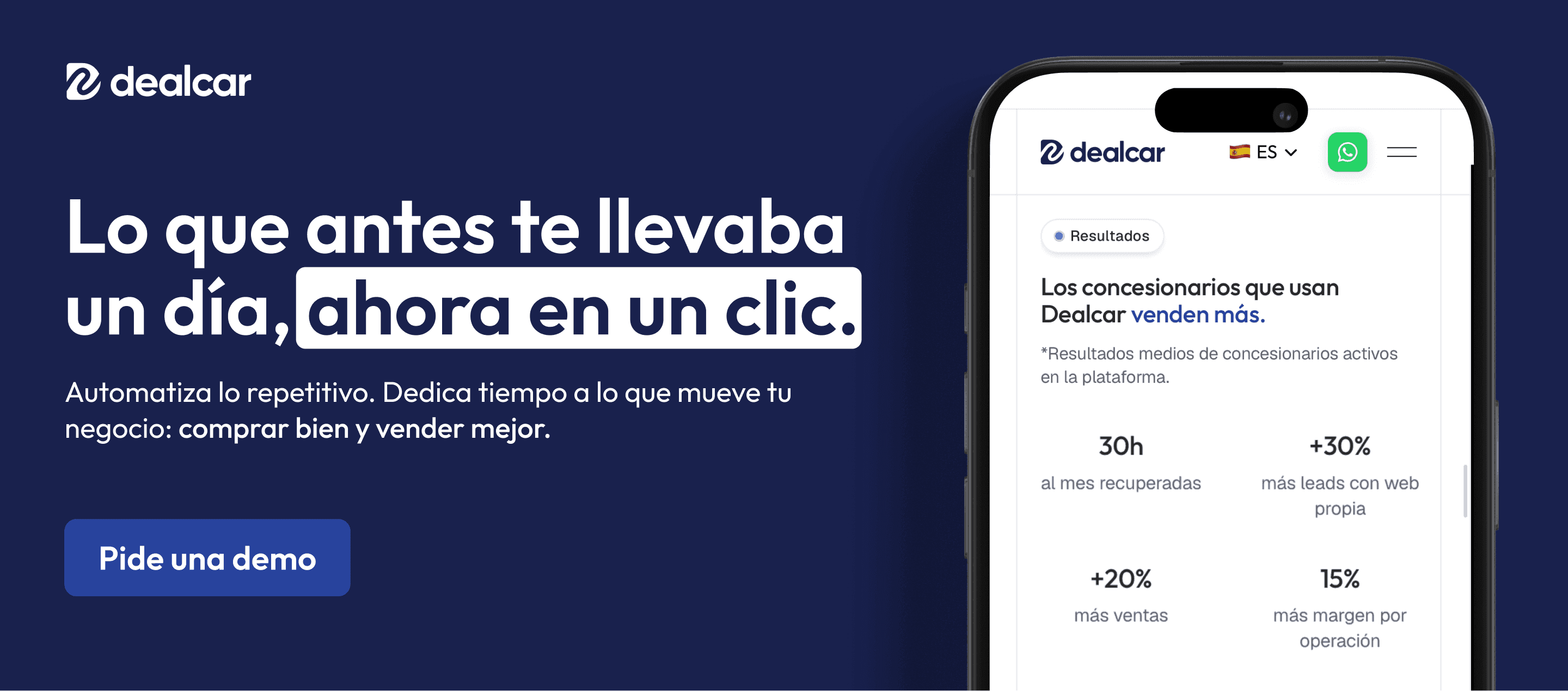
Dealcar tracks the source of each lead (portal, WhatsApp, web, Google VLA) and calculates the conversion rate per channel. This visibility allows you to make marketing investment decisions based on your own business data, not general market estimates.
You can see how it works at dealcar.io/crm-leads-automocion or request a demo at dealcar.io.
Frequently asked questions
Where should a dealership that has never done digital marketing before start?
In order: verified and optimised Google Business Profile, active reviews, website with synchronised stock and Google VLA activated. With those four elements working, the dealership has local organic presence, visibility in product searches and lead acquisition without cost-per-click in many cases. The rest (Meta Ads, email, social media) is added once the foundation is already generating results.
How much marketing budget does an independent dealership need?
To start with VLA and a small Meta Ads campaign, between £200 and £400 per month is enough to get real data in the first 60 days. Reviews, local SEO and social media do not require an advertising budget, only time.
Is it worth hiring a marketing agency for a small dealership?
It depends. An agency specialising in the automotive sector can add real value in managing VLA and Meta Ads. A generalist agency that doesn't know the sector usually proposes strategies designed for another type of business that don't fit the operations of a used car dealership.