In the world of buying and selling second-hand vehicles, professional sellers must comply with a series of legal obligations to protect consumers' rights and avoid possible disputes.
This detailed guide will help you understand the essential contracts you should use as a professional car seller, as well as the key clauses and responsibilities they entail.
Contents
Importance of contracts in car sales
Vehicle sale and purchase contract with warranty
Legal obligations of the professional seller
Essential clauses in sale and purchase contracts
Legal and commercial warranty: differences and application
Seller's liability for hidden defects
Documentation required to formalise the sale
Importance of offering digital signature
Recommendations for a safe and transparent transaction
Importance of contracts in car sales
The buying and selling of vehicles is a complex activity that involves risks and responsibilities for both parties involved. That is why contracts play a fundamental role, as they establish the rights and obligations of each party, protecting their interests and preventing possible future disputes. A well-drafted, detailed contract is essential to ensure a safe and transparent transaction.
In addition, in the case of professional sellers, contracts are an essential tool for complying with legal obligations and avoiding sanctions or claims from buyers. An appropriate contract protects both seller and buyer, clearly setting out the terms and conditions of the sale.
Vehicle sale and purchase contract with warranty
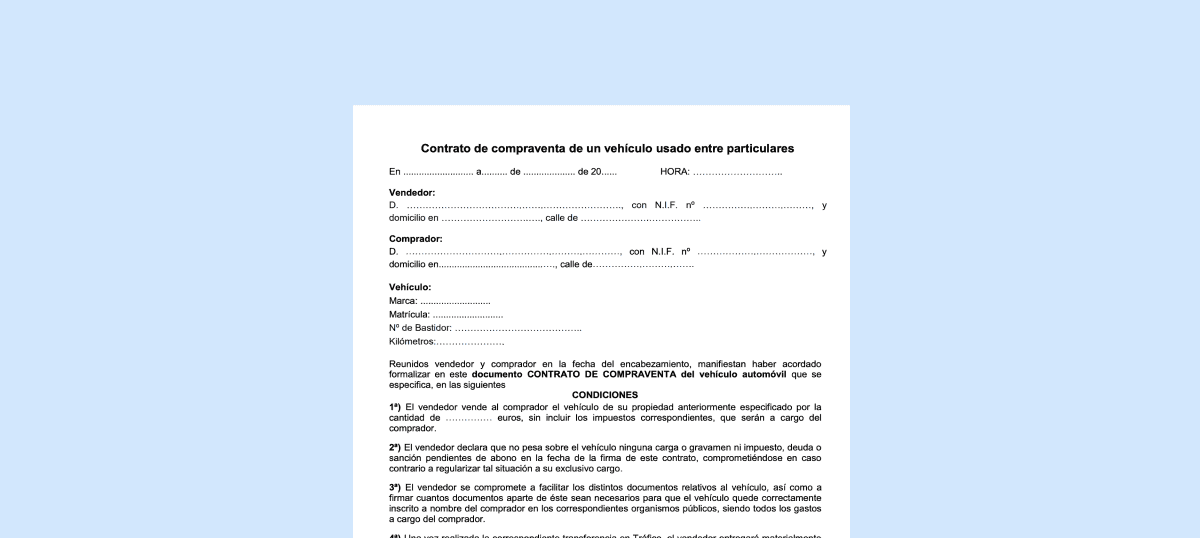
The vehicle sale and purchase contract with warranty is the main document that must be used when selling used cars by a professional seller. This contract must include detailed information about the vehicle, the parties involved and, most importantly, the terms of the legal warranty that the seller is required to provide.
Some of the key elements that must be included in this contract are:
Seller and buyer details
Full vehicle description (make, model, year, registration number, chassis number, etc.)
Sale price and method of payment
Legal warranty period (minimum of one year, according to the law)
Warranty terms and limitations
Vehicle delivery date
It is important to note that, according to the General Act for the Defence of Consumers and Users, the professional seller must offer a two-year legal warranty. However, this warranty can be reduced to one year if both parties agree in writing in the contract.
Legal obligations of the professional seller
Professional car sellers have a series of legal obligations that they must comply with in order to protect consumers' rights. Some of these obligations are:
Offer a minimum legal warranty of one year: As mentioned above, the law states that the professional seller must offer a two-year legal warranty, but this can be reduced to one year if agreed in writing in the contract.
Be liable for hidden defects: The seller is responsible for any hidden defect that the vehicle may have and that was not apparent at the time of purchase. This will be covered in more detail in a later section.
Provide truthful information: The seller must provide accurate and complete information about the condition of the vehicle, its maintenance history and any other relevant information that may influence the customer's buying decision.
Comply with consumer protection rules: Professional sellers must comply with all rules and regulations established to protect consumers' rights, including providing invoices, warranties and any other required documentation.
Failure to comply with these obligations may result in administrative penalties, claims from buyers and even legal action.
Essential clauses in sale and purchase contracts
In addition to the basic elements mentioned above, vehicle sale and purchase contracts must include a series of essential clauses that protect the interests of both parties. Some of these clauses are:
Warranty clause: This clause must set out the term of the legal warranty, the coverage conditions and any exclusions, if applicable.
Dispute resolution clause: This clause establishes the procedure to follow in the event of disputes or disagreements between seller and buyer, including the possibility of going to arbitration or to the courts.
Ownership transfer clause: This clause indicates the moment at which ownership of the vehicle is transferred to the buyer, as well as each party's responsibilities in the transfer process.
Limitation of liability clause: This clause limits the seller's liability in the event of damage or loss arising from the use of the vehicle after the sale.
Confidentiality clause: This clause protects both parties' confidential information, such as personal data or financial information.
It is important that these clauses are drafted clearly and precisely, avoiding ambiguities or misinterpretations that could lead to future disputes.
Legal and commercial warranty: differences and application
In the field of vehicle sales, it is important to distinguish between the legal warranty and the commercial warranty, as both have different characteristics and applications.
Legal warranty
The legal warranty is the one the professional seller is required to offer by law. As mentioned above, this warranty has a minimum duration of one year and covers any hidden defect or lack of conformity that the vehicle may have at the time of delivery.
The legal warranty cannot be waived and cannot be limited or excluded by the seller. Any clause in the contract that attempts to limit or nullify this warranty will be considered void and without effect.
Commercial warranty
On the other hand, the commercial warranty is an additional warranty that the seller may offer voluntarily to provide greater protection to the buyer. This warranty may cover additional aspects, such as maintenance or repair of certain vehicle components.
Unlike the legal warranty, the commercial warranty is optional and can be negotiated between seller and buyer. However, it is important to bear in mind that the commercial warranty cannot replace or limit the mandatory legal warranty.
In short, while the legal warranty is a legal requirement that the professional seller must comply with, the commercial warranty is an additional option that can be offered to provide greater added value to the buyer.
Seller's liability for hidden defects
One of the most important aspects that must be addressed in vehicle sale and purchase contracts is the seller's liability in the presence of hidden defects. According to the Spanish Civil Code, the seller is obliged to guarantee the absence of hidden defects in the vehicle sold that make it unsuitable for the use for which it is intended, or that reduce its usefulness to such an extent that, had the buyer known about them, they would not have bought it or would have paid less for it.
The seller is liable for these hidden defects, even if they had no knowledge of them at the time of sale. That is why it is essential to carry out a thorough inspection of the vehicle before proceeding with the transaction, and to record its condition in the contract.
If the buyer discovers hidden defects after the purchase, they have the right to make a claim against the seller and request a repair, a price reduction or even the termination of the contract, depending on the seriousness of the defect.
Documentation required to formalise the sale
In addition to the sale and purchase contract, there are other documents needed to formalise the sale of a vehicle legally and correctly. Some of these documents are:
Sale and purchase contract: As mentioned above, this document is essential and must include all the details of the transaction and the relevant clauses.
Proof of payment of the Property Transfer Tax (ITP): This tax must be paid in the autonomous community corresponding to the buyer's tax residence.
Vehicle documentation: The seller must hand over to the buyer all documentation relating to the vehicle, such as the registration certificate, the technical data sheet, the maintenance history, among others.
Sale notification: It is advisable for the seller to file a sale notification with the DGT to avoid possible future liabilities related to the vehicle.
It is important to bear in mind that the process of transferring ownership of the vehicle must be carried out within 30 days after signing the sale and purchase contract.
Importance of offering digital signature
The addition of digital signature to vehicle sale and purchase contracts not only improves the speed of the signing process, but also offers a number of additional benefits. Digital signature allows documents to be validated quickly and securely, guarantees the integrity of the contract, and significantly reduces the possibility of fraud or unauthorised alterations.
In addition, the use of digital signature makes it easier to manage and store contracts, eliminating the need for physical space and reducing the costs associated with printing and handling paper documents. This not only streamlines administrative processes, but also contributes to sustainability and the reduction of the carbon footprint.
For all these reasons, it is highly advisable for professional sellers to adopt digital signature systems, which will allow for greater efficiency and security in all transactions.
Recommendations for a safe and transparent transaction
To ensure a safe and transparent transaction in the sale and purchase of used vehicles, both sellers and buyers should follow certain recommendations:
Inspect the vehicle thoroughly: Before proceeding with the purchase, it is essential to carry out a complete inspection of the vehicle, including a mechanical check and verification of its history.
Request a detailed vehicle report: The DGT offers the possibility of requesting a detailed vehicle report, which includes administrative, technical and maintenance information.
Read the contract carefully: Both seller and buyer should read and understand all the clauses and conditions of the contract before signing it.
Make the payment securely: It is advisable to use secure payment methods, such as bank transfers or certified cheques, and obtain proof of payment.
Formalise the transfer of ownership: It is essential to complete the necessary procedures to legally transfer ownership of the vehicle to the buyer within the established time limit.
By following these recommendations and complying with the corresponding legal obligations, both sellers and buyers can enjoy a safe and satisfactory transaction in the sale and purchase of used vehicles.
In the world of buying and selling second-hand vehicles, professional sellers must comply with a series of legal obligations to protect consumers' rights and avoid possible disputes.
This detailed guide will help you understand the essential contracts you should use as a professional car seller, as well as the key clauses and responsibilities they entail.
Contents
Importance of contracts in car sales
Vehicle sale and purchase contract with warranty
Legal obligations of the professional seller
Essential clauses in sale and purchase contracts
Legal and commercial warranty: differences and application
Seller's liability for hidden defects
Documentation required to formalise the sale
Importance of offering digital signature
Recommendations for a safe and transparent transaction
Importance of contracts in car sales
The buying and selling of vehicles is a complex activity that involves risks and responsibilities for both parties involved. That is why contracts play a fundamental role, as they establish the rights and obligations of each party, protecting their interests and preventing possible future disputes. A well-drafted, detailed contract is essential to ensure a safe and transparent transaction.
In addition, in the case of professional sellers, contracts are an essential tool for complying with legal obligations and avoiding sanctions or claims from buyers. An appropriate contract protects both seller and buyer, clearly setting out the terms and conditions of the sale.
Vehicle sale and purchase contract with warranty
The vehicle sale and purchase contract with warranty is the main document that must be used when selling used cars by a professional seller. This contract must include detailed information about the vehicle, the parties involved and, most importantly, the terms of the legal warranty that the seller is required to provide.
Some of the key elements that must be included in this contract are:
Seller and buyer details
Full vehicle description (make, model, year, registration number, chassis number, etc.)
Sale price and method of payment
Legal warranty period (minimum of one year, according to the law)
Warranty terms and limitations
Vehicle delivery date
It is important to note that, according to the General Act for the Defence of Consumers and Users, the professional seller must offer a two-year legal warranty. However, this warranty can be reduced to one year if both parties agree in writing in the contract.
Legal obligations of the professional seller
Professional car sellers have a series of legal obligations that they must comply with in order to protect consumers' rights. Some of these obligations are:
Offer a minimum legal warranty of one year: As mentioned above, the law states that the professional seller must offer a two-year legal warranty, but this can be reduced to one year if agreed in writing in the contract.
Be liable for hidden defects: The seller is responsible for any hidden defect that the vehicle may have and that was not apparent at the time of purchase. This will be covered in more detail in a later section.
Provide truthful information: The seller must provide accurate and complete information about the condition of the vehicle, its maintenance history and any other relevant information that may influence the customer's buying decision.
Comply with consumer protection rules: Professional sellers must comply with all rules and regulations established to protect consumers' rights, including providing invoices, warranties and any other required documentation.
Failure to comply with these obligations may result in administrative penalties, claims from buyers and even legal action.
Essential clauses in sale and purchase contracts
In addition to the basic elements mentioned above, vehicle sale and purchase contracts must include a series of essential clauses that protect the interests of both parties. Some of these clauses are:
Warranty clause: This clause must set out the term of the legal warranty, the coverage conditions and any exclusions, if applicable.
Dispute resolution clause: This clause establishes the procedure to follow in the event of disputes or disagreements between seller and buyer, including the possibility of going to arbitration or to the courts.
Ownership transfer clause: This clause indicates the moment at which ownership of the vehicle is transferred to the buyer, as well as each party's responsibilities in the transfer process.
Limitation of liability clause: This clause limits the seller's liability in the event of damage or loss arising from the use of the vehicle after the sale.
Confidentiality clause: This clause protects both parties' confidential information, such as personal data or financial information.
It is important that these clauses are drafted clearly and precisely, avoiding ambiguities or misinterpretations that could lead to future disputes.
Legal and commercial warranty: differences and application
In the field of vehicle sales, it is important to distinguish between the legal warranty and the commercial warranty, as both have different characteristics and applications.
Legal warranty
The legal warranty is the one the professional seller is required to offer by law. As mentioned above, this warranty has a minimum duration of one year and covers any hidden defect or lack of conformity that the vehicle may have at the time of delivery.
The legal warranty cannot be waived and cannot be limited or excluded by the seller. Any clause in the contract that attempts to limit or nullify this warranty will be considered void and without effect.
Commercial warranty
On the other hand, the commercial warranty is an additional warranty that the seller may offer voluntarily to provide greater protection to the buyer. This warranty may cover additional aspects, such as maintenance or repair of certain vehicle components.
Unlike the legal warranty, the commercial warranty is optional and can be negotiated between seller and buyer. However, it is important to bear in mind that the commercial warranty cannot replace or limit the mandatory legal warranty.
In short, while the legal warranty is a legal requirement that the professional seller must comply with, the commercial warranty is an additional option that can be offered to provide greater added value to the buyer.
Seller's liability for hidden defects
One of the most important aspects that must be addressed in vehicle sale and purchase contracts is the seller's liability in the presence of hidden defects. According to the Spanish Civil Code, the seller is obliged to guarantee the absence of hidden defects in the vehicle sold that make it unsuitable for the use for which it is intended, or that reduce its usefulness to such an extent that, had the buyer known about them, they would not have bought it or would have paid less for it.
The seller is liable for these hidden defects, even if they had no knowledge of them at the time of sale. That is why it is essential to carry out a thorough inspection of the vehicle before proceeding with the transaction, and to record its condition in the contract.
If the buyer discovers hidden defects after the purchase, they have the right to make a claim against the seller and request a repair, a price reduction or even the termination of the contract, depending on the seriousness of the defect.
Documentation required to formalise the sale
In addition to the sale and purchase contract, there are other documents needed to formalise the sale of a vehicle legally and correctly. Some of these documents are:
Sale and purchase contract: As mentioned above, this document is essential and must include all the details of the transaction and the relevant clauses.
Proof of payment of the Property Transfer Tax (ITP): This tax must be paid in the autonomous community corresponding to the buyer's tax residence.
Vehicle documentation: The seller must hand over to the buyer all documentation relating to the vehicle, such as the registration certificate, the technical data sheet, the maintenance history, among others.
Sale notification: It is advisable for the seller to file a sale notification with the DGT to avoid possible future liabilities related to the vehicle.
It is important to bear in mind that the process of transferring ownership of the vehicle must be carried out within 30 days after signing the sale and purchase contract.
Importance of offering digital signature
The addition of digital signature to vehicle sale and purchase contracts not only improves the speed of the signing process, but also offers a number of additional benefits. Digital signature allows documents to be validated quickly and securely, guarantees the integrity of the contract, and significantly reduces the possibility of fraud or unauthorised alterations.
In addition, the use of digital signature makes it easier to manage and store contracts, eliminating the need for physical space and reducing the costs associated with printing and handling paper documents. This not only streamlines administrative processes, but also contributes to sustainability and the reduction of the carbon footprint.
For all these reasons, it is highly advisable for professional sellers to adopt digital signature systems, which will allow for greater efficiency and security in all transactions.
Recommendations for a safe and transparent transaction
To ensure a safe and transparent transaction in the sale and purchase of used vehicles, both sellers and buyers should follow certain recommendations:
Inspect the vehicle thoroughly: Before proceeding with the purchase, it is essential to carry out a complete inspection of the vehicle, including a mechanical check and verification of its history.
Request a detailed vehicle report: The DGT offers the possibility of requesting a detailed vehicle report, which includes administrative, technical and maintenance information.
Read the contract carefully: Both seller and buyer should read and understand all the clauses and conditions of the contract before signing it.
Make the payment securely: It is advisable to use secure payment methods, such as bank transfers or certified cheques, and obtain proof of payment.
Formalise the transfer of ownership: It is essential to complete the necessary procedures to legally transfer ownership of the vehicle to the buyer within the established time limit.
By following these recommendations and complying with the corresponding legal obligations, both sellers and buyers can enjoy a safe and satisfactory transaction in the sale and purchase of used vehicles.