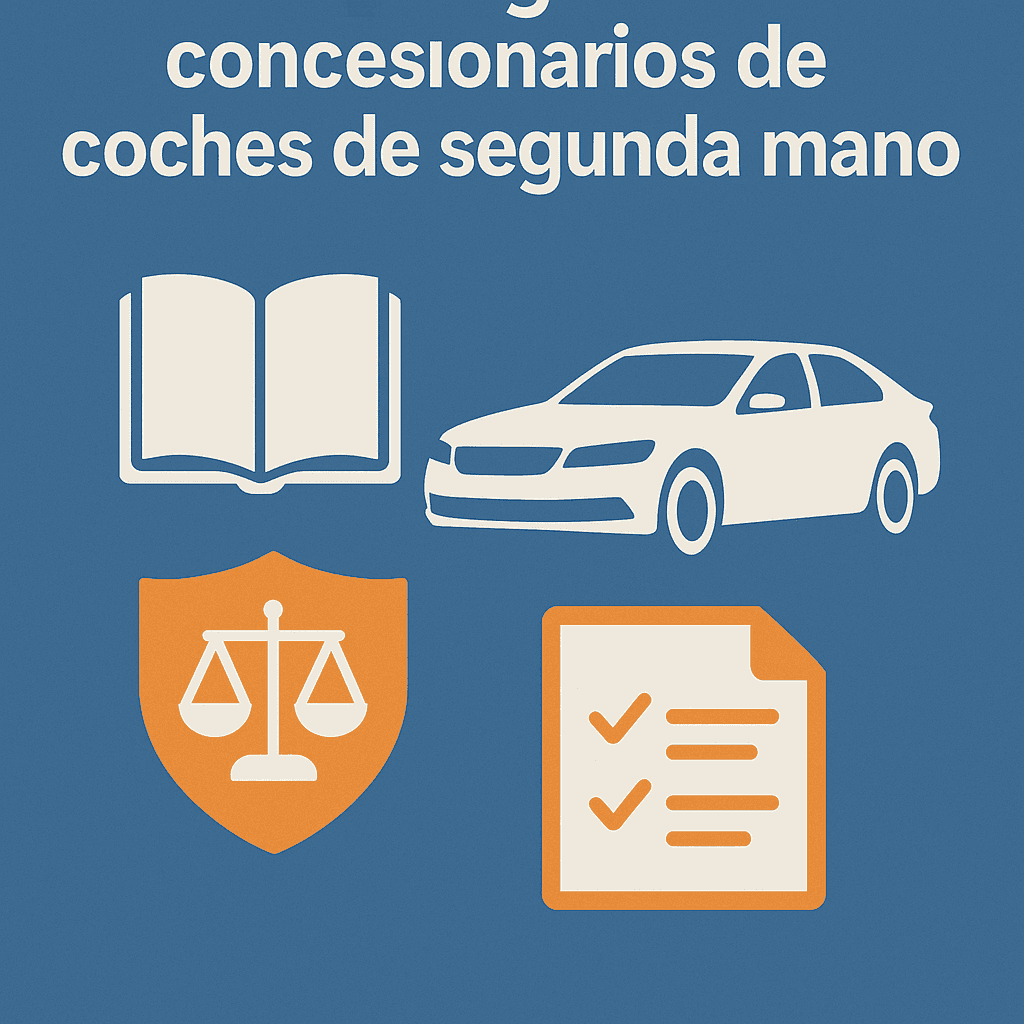
The buying and selling of used vehicles is a highly regulated activity in Spain, especially when carried out professionally. For a used-car dealership, knowing and correctly applying the legal regulations is essential to avoid penalties, disputes with customers and damage to the business’s reputation.
In this guide, we explain in a clear and practical way the key legal obligations that a used-car dealership must meet, from warranties to mandatory documentation, as well as the most relevant regulations and the risks of failing to comply with them.
Basic legal obligations for dealerships
Registering as a company or sole trader
The first step is to operate legally as a company or self-employed worker, registered with the tax office and Social Security, under the corresponding category for vehicle buying and selling. It is also advisable to have the correct CNAE code (such as 4511 or 4519) to avoid problems with public authorities or insurers.
Vehicle trader register
In some autonomous communities (such as Catalonia, Madrid or Andalusia), it is mandatory to register in a specific vehicle traders’ register. This register makes administrative control easier and is required for certain procedures, such as mass registrations or online administrative processes.
Clear and detailed contracts
Every car sold must have a detailed sales contract specifying the condition of the vehicle, warranties offered, price and terms. This protects both the buyer and the dealership in the event of possible disputes. It should also be stated whether the vehicle has suffered accidents or structural repairs.
Data protection (LOPDGDD and GDPR)
If you collect customers’ personal data (in forms, CRM systems, etc.), you must comply with the Organic Law on Data Protection and the European regulations (GDPR). This includes:
Informing people about how their data will be used
Requesting explicit consent
Guaranteeing the right of access, rectification and erasure
Keeping a record of processing activities
Legal warranties in the sale of used cars
Sales to private individuals
When you sell to a final consumer, you are required to offer a minimum 1-year warranty. This warranty covers defects that were not visible at the time of purchase and are not the result of normal use. In addition, if the defect appears within the first 6 months, it is presumed to have already existed unless proven otherwise.
Sales between professionals
If you sell to another professional (for example, another dealership), warranties may be different or even waived, provided this is set out in writing. Even so, it is advisable to offer a minimum warranty to foster healthy business relationships.
Warranty documentation
It must be provided in writing, detailing the scope, duration, exclusions and the procedure for enforcing it. Including contact details for complaints is essential.
Mandatory documentation in vehicle sales
Registration document and ITV inspection
The vehicle must have a valid registration document and, where applicable due to its age, have passed the ITV inspection. A car cannot be sold without this documentation, unless it is expressly stated that it is being sold for parts or as non-roadworthy.
DGT report
It is advisable to provide or make available to the buyer an official report from the Directorate-General for Traffic showing the vehicle’s history: liens, fines, ownership, recorded mileage, number of previous owners, etc.
Sales contract
It must include the details of both parties, identification of the vehicle, price, payment method, warranties, delivery date and special conditions. An appendix with photographs of the vehicle and the exact mileage may also be included.
Taxes and fees
The dealership must manage:
Payment of the Transfer Tax (if applicable)
The fee for the change of ownership with Traffic
Issuing invoices with VAT itemised if operating under the standard regime or the special used-goods regime (REBU)
Relevant regulations for used-car dealerships
General Law for the Defence of Consumers
It regulates sales conditions and minimum warranties when dealing with private customers. It requires truthful, accessible and verifiable information about the product.
Environmental rules
Dealerships must take into account:
Low Emission Zones (LEZ)
DGT environmental labels
Restrictions for cars without a sticker in major cities
This affects both sales and stock turnover. Informing the customer is part of the legal obligation.
Transparency and advertising
The information shown in advertisements must be truthful and verifiable. It is illegal to advertise a car with features it does not have or with a misleading price. The use of tactics such as "loss leader" pricing can be penalised as unfair competition.
Civil liability regulations
It is advisable, although not mandatory, for dealerships to have professional civil liability insurance covering errors, claims or damage arising from the activity.
Legal tips to avoid claims
Total transparency: Clearly explain the condition of the vehicle, mileage, servicing and any known defects.
Put everything in writing: Reaching verbal agreements can lead to misunderstandings. Always document the terms.
Good after-sales service: Managing any issue professionally protects your reputation and reduces legal risks.
Civil liability insurance: Helps cover unexpected legal issues or damage arising from professional activity.
Continuous training: Keep up to date with webinars, legal advice or sector associations to stay informed about legal changes.
Conclusion
Complying with the law is not an option; it is a necessity for any used-car dealership. In addition to avoiding penalties, it builds trust with customers and improves the business’s competitiveness.
Having good advice, keeping documentation up to date and training your team in legal obligations will allow you to focus on what really matters: selling transparently and growing sustainably.
Frequently asked questions
How much warranty must a dealership offer for a used car?
At least 1 year if the buyer is a private individual, according to current legislation in Spain.
What documents must a dealership provide when selling a car?
Sales contract, registration document, ITV inspection, tax receipt, invoice and proof of change of ownership.
Can a dealership sell a car without an ITV?
No, except in specific cases (for parts or not for use on public roads) and this must be clearly stated in the contract.
Do I need legal advice for my dealership?
Yes. Having a specialist lawyer or adviser helps avoid problems and ensures that all legal obligations are met.
What happens if I do not comply with the legal warranty?
The customer can make a claim, go to Consumer Affairs and even start legal proceedings. Penalties may include compensation and administrative fines.
Do you want to stay up to date with the legal obligations of your dealership? At Dealcar we help you manage your business with complete legal certainty and without complications.
The buying and selling of used vehicles is a highly regulated activity in Spain, especially when carried out professionally. For a used-car dealership, knowing and correctly applying the legal regulations is essential to avoid penalties, disputes with customers and damage to the business’s reputation.
In this guide, we explain in a clear and practical way the key legal obligations that a used-car dealership must meet, from warranties to mandatory documentation, as well as the most relevant regulations and the risks of failing to comply with them.
Basic legal obligations for dealerships
Registering as a company or sole trader
The first step is to operate legally as a company or self-employed worker, registered with the tax office and Social Security, under the corresponding category for vehicle buying and selling. It is also advisable to have the correct CNAE code (such as 4511 or 4519) to avoid problems with public authorities or insurers.
Vehicle trader register
In some autonomous communities (such as Catalonia, Madrid or Andalusia), it is mandatory to register in a specific vehicle traders’ register. This register makes administrative control easier and is required for certain procedures, such as mass registrations or online administrative processes.
Clear and detailed contracts
Every car sold must have a detailed sales contract specifying the condition of the vehicle, warranties offered, price and terms. This protects both the buyer and the dealership in the event of possible disputes. It should also be stated whether the vehicle has suffered accidents or structural repairs.
Data protection (LOPDGDD and GDPR)
If you collect customers’ personal data (in forms, CRM systems, etc.), you must comply with the Organic Law on Data Protection and the European regulations (GDPR). This includes:
Informing people about how their data will be used
Requesting explicit consent
Guaranteeing the right of access, rectification and erasure
Keeping a record of processing activities
Legal warranties in the sale of used cars
Sales to private individuals
When you sell to a final consumer, you are required to offer a minimum 1-year warranty. This warranty covers defects that were not visible at the time of purchase and are not the result of normal use. In addition, if the defect appears within the first 6 months, it is presumed to have already existed unless proven otherwise.
Sales between professionals
If you sell to another professional (for example, another dealership), warranties may be different or even waived, provided this is set out in writing. Even so, it is advisable to offer a minimum warranty to foster healthy business relationships.
Warranty documentation
It must be provided in writing, detailing the scope, duration, exclusions and the procedure for enforcing it. Including contact details for complaints is essential.
Mandatory documentation in vehicle sales
Registration document and ITV inspection
The vehicle must have a valid registration document and, where applicable due to its age, have passed the ITV inspection. A car cannot be sold without this documentation, unless it is expressly stated that it is being sold for parts or as non-roadworthy.
DGT report
It is advisable to provide or make available to the buyer an official report from the Directorate-General for Traffic showing the vehicle’s history: liens, fines, ownership, recorded mileage, number of previous owners, etc.
Sales contract
It must include the details of both parties, identification of the vehicle, price, payment method, warranties, delivery date and special conditions. An appendix with photographs of the vehicle and the exact mileage may also be included.
Taxes and fees
The dealership must manage:
Payment of the Transfer Tax (if applicable)
The fee for the change of ownership with Traffic
Issuing invoices with VAT itemised if operating under the standard regime or the special used-goods regime (REBU)
Relevant regulations for used-car dealerships
General Law for the Defence of Consumers
It regulates sales conditions and minimum warranties when dealing with private customers. It requires truthful, accessible and verifiable information about the product.
Environmental rules
Dealerships must take into account:
Low Emission Zones (LEZ)
DGT environmental labels
Restrictions for cars without a sticker in major cities
This affects both sales and stock turnover. Informing the customer is part of the legal obligation.
Transparency and advertising
The information shown in advertisements must be truthful and verifiable. It is illegal to advertise a car with features it does not have or with a misleading price. The use of tactics such as "loss leader" pricing can be penalised as unfair competition.
Civil liability regulations
It is advisable, although not mandatory, for dealerships to have professional civil liability insurance covering errors, claims or damage arising from the activity.
Legal tips to avoid claims
Total transparency: Clearly explain the condition of the vehicle, mileage, servicing and any known defects.
Put everything in writing: Reaching verbal agreements can lead to misunderstandings. Always document the terms.
Good after-sales service: Managing any issue professionally protects your reputation and reduces legal risks.
Civil liability insurance: Helps cover unexpected legal issues or damage arising from professional activity.
Continuous training: Keep up to date with webinars, legal advice or sector associations to stay informed about legal changes.
Conclusion
Complying with the law is not an option; it is a necessity for any used-car dealership. In addition to avoiding penalties, it builds trust with customers and improves the business’s competitiveness.
Having good advice, keeping documentation up to date and training your team in legal obligations will allow you to focus on what really matters: selling transparently and growing sustainably.
Frequently asked questions
How much warranty must a dealership offer for a used car?
At least 1 year if the buyer is a private individual, according to current legislation in Spain.
What documents must a dealership provide when selling a car?
Sales contract, registration document, ITV inspection, tax receipt, invoice and proof of change of ownership.
Can a dealership sell a car without an ITV?
No, except in specific cases (for parts or not for use on public roads) and this must be clearly stated in the contract.
Do I need legal advice for my dealership?
Yes. Having a specialist lawyer or adviser helps avoid problems and ensures that all legal obligations are met.
What happens if I do not comply with the legal warranty?
The customer can make a claim, go to Consumer Affairs and even start legal proceedings. Penalties may include compensation and administrative fines.
Do you want to stay up to date with the legal obligations of your dealership? At Dealcar we help you manage your business with complete legal certainty and without complications.