🛠️ Introduction
Buying a car to resell is not just a matter of getting a good price. As a professional, you know that a mistake at the point of purchase can cost you time, money and reputation. From mechanical problems you didn’t spot at first glance to cars with outstanding charges that can’t be transferred, the risks are there.
This guide is designed so you can carry out a quick and effective checklist before any purchase, whether you buy from a private seller, at auction, through leasing, from fleets or from other car dealers.
1. Basic mechanical inspection (even if you’re not a mechanic)
Even if you don’t have a lift or an OBD scanner to hand, there are many points you can check yourself to avoid surprises:
Item | What to check | Warning signs |
|---|---|---|
Engine | Noises, smoke, stable idle, visible leaks | Blue smoke (oil), white smoke (head gasket), unstable idle |
Transmission | Smooth gear changes (manual or automatic) | Grinding, jerking or delay when changing gears |
Steering and suspension | Turn the steering wheel, go over speed bumps | Noises when turning, uneven sinking |
Brakes and wheels | Wear on pads, discs, vibration when braking | Spongy pedal, uneven tyre wear |
Lights, wipers, air conditioning, interiors | Everything should work | Poor interior condition = generally poor care |
Dealcar tip: If the car is cold, start it and let it idle for 2–3 minutes. If you notice instability, jerking or unusual smoke, reject it or negotiate very aggressively.
2. Documentation: without the proper paperwork, there’s no deal
Before making any payment or commitment, check that all the documentation is correct:
✅ Registration certificate and original V5C/technical data sheet
✅ Valid MOT or one close to expiry
✅ Service history if available (service book stamp, invoices, PDF)
✅ DGT, Carfax, AutoDNA or similar report
✅ Sales contract properly drafted, even if you’re buying from another professional
Key points to review in the DGT report:
Actual number of previous keepers
Whether the vehicle is off the road, has charges, ownership reservation or liens
Mileage recorded at the last MOTs
Existence of recorded accidents or total loss
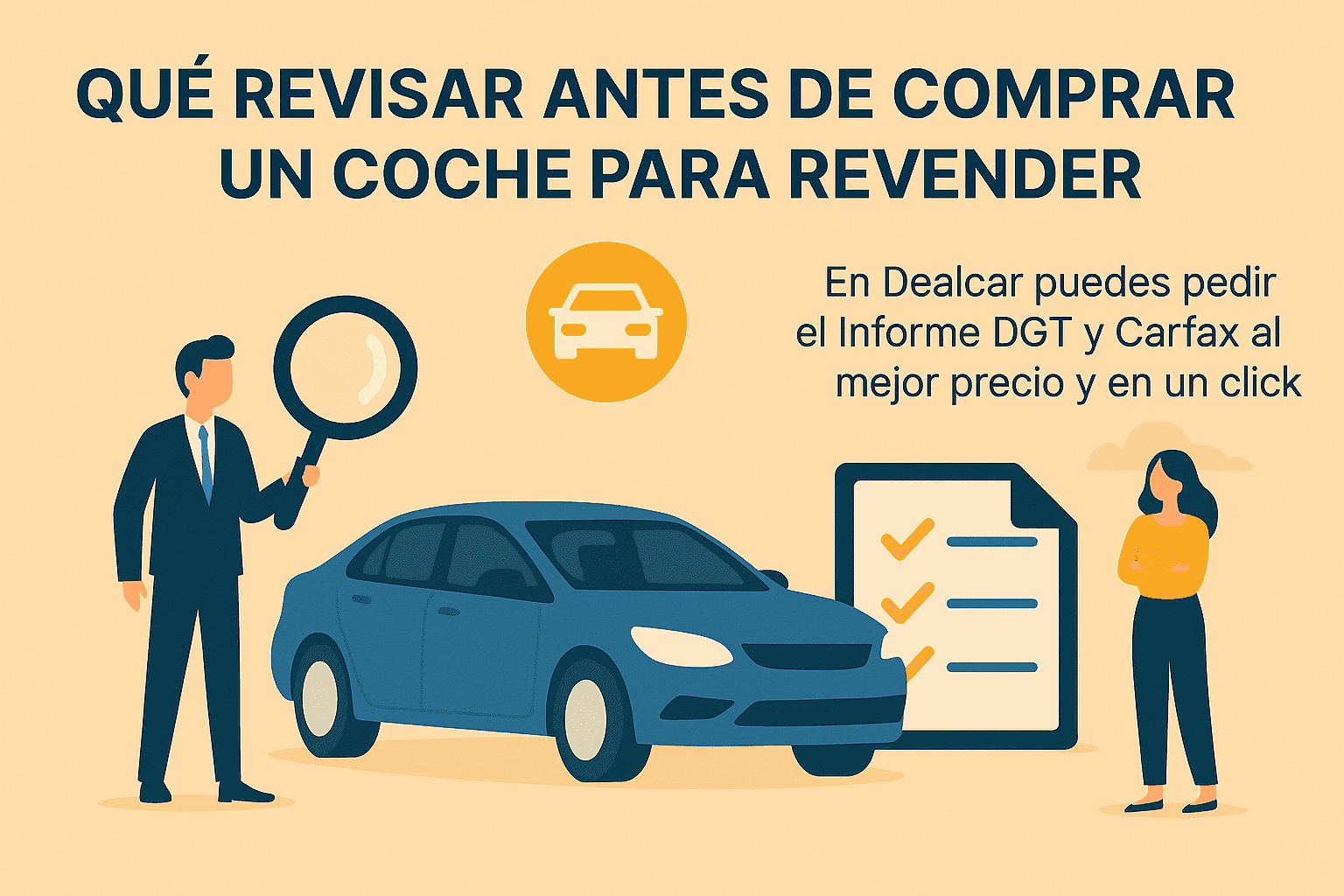
👉 At Dealcar you can request the DGT and Carfax reports directly at the best price and in one click, without leaving the system and linking them automatically to the car’s record.
Practical tip: If the original V5C or registration certificate is missing, require a duplicate to be processed before buying. Otherwise, you could end up with a car that cannot be transferred into your name.
3. Is there real profit margin? How to estimate it
Before buying, assess whether the car has enough margin to resell. Do it in 3 steps:
1. Realistic mileage
Has it been tampered with? Compare the MOT history with the odometer.
Does it make sense given the type of use, year and interior condition?
2. Market value
Check similar adverts in your area and on portals such as Coches.net, Wallapop and Milanuncios.
Assess condition, extras, colour, exact trim, gearbox type and whether it has an environmental label.
3. Calculate your total cost
Don’t stop at the purchase price. Add:
Transport, cleaning, repair or polishing
Cost of getting it ready for sale (MOT, battery, tyres…)
Agency fees or charges
Mandatory warranty (if selling to a private buyer)
Golden rule for small dealers: never buy anything that won’t leave you at least €800–€1,200 net margin, unless it’s a very fast turnover or you already have a customer.
4. Signs of a scam or risk of problems
Even if it looks like a bargain, if something doesn’t add up, it’s better not to buy. These are the signs that should put you on alert:
❌ Seller who avoids giving you their ID, registration document or keeper details
❌ Price far below market value with no justification
❌ History with several keeper changes in a short period
❌ Foreign car without homologated documentation
❌ Recent failed MOT not rectified
❌ Silence or evasive answers to basic questions
Tip: search the registration number or chassis number on Google. Sometimes there are duplicate adverts or reported cases on forums.
✅ Practical conclusion
Buying well is the first step to selling well. And as a professional, that means carrying out a quick but thorough inspection of the car and everything around it.
Carry out a basic visual and functional check of the vehicle.
Check that all documentation is complete and problem-free.
Calculate your real margin, including all associated costs.
Avoid risky purchases, even if the price looks tempting.
👉 With Dealcar you can request DGT and Carfax reports directly in one click and at the best price, linking them to the car’s record. In addition, you can organise your stock, store documentation and keep track of each unit like a professional.
https://www.dealcar.io/informe-carfax-dgt
Want to see it in action?
Request a free demo and start working more efficiently from now on.
🛠️ Introduction
Buying a car to resell is not just a matter of getting a good price. As a professional, you know that a mistake at the point of purchase can cost you time, money and reputation. From mechanical problems you didn’t spot at first glance to cars with outstanding charges that can’t be transferred, the risks are there.
This guide is designed so you can carry out a quick and effective checklist before any purchase, whether you buy from a private seller, at auction, through leasing, from fleets or from other car dealers.
1. Basic mechanical inspection (even if you’re not a mechanic)
Even if you don’t have a lift or an OBD scanner to hand, there are many points you can check yourself to avoid surprises:
Item | What to check | Warning signs |
|---|---|---|
Engine | Noises, smoke, stable idle, visible leaks | Blue smoke (oil), white smoke (head gasket), unstable idle |
Transmission | Smooth gear changes (manual or automatic) | Grinding, jerking or delay when changing gears |
Steering and suspension | Turn the steering wheel, go over speed bumps | Noises when turning, uneven sinking |
Brakes and wheels | Wear on pads, discs, vibration when braking | Spongy pedal, uneven tyre wear |
Lights, wipers, air conditioning, interiors | Everything should work | Poor interior condition = generally poor care |
Dealcar tip: If the car is cold, start it and let it idle for 2–3 minutes. If you notice instability, jerking or unusual smoke, reject it or negotiate very aggressively.
2. Documentation: without the proper paperwork, there’s no deal
Before making any payment or commitment, check that all the documentation is correct:
✅ Registration certificate and original V5C/technical data sheet
✅ Valid MOT or one close to expiry
✅ Service history if available (service book stamp, invoices, PDF)
✅ DGT, Carfax, AutoDNA or similar report
✅ Sales contract properly drafted, even if you’re buying from another professional
Key points to review in the DGT report:
Actual number of previous keepers
Whether the vehicle is off the road, has charges, ownership reservation or liens
Mileage recorded at the last MOTs
Existence of recorded accidents or total loss
👉 At Dealcar you can request the DGT and Carfax reports directly at the best price and in one click, without leaving the system and linking them automatically to the car’s record.
Practical tip: If the original V5C or registration certificate is missing, require a duplicate to be processed before buying. Otherwise, you could end up with a car that cannot be transferred into your name.
3. Is there real profit margin? How to estimate it
Before buying, assess whether the car has enough margin to resell. Do it in 3 steps:
1. Realistic mileage
Has it been tampered with? Compare the MOT history with the odometer.
Does it make sense given the type of use, year and interior condition?
2. Market value
Check similar adverts in your area and on portals such as Coches.net, Wallapop and Milanuncios.
Assess condition, extras, colour, exact trim, gearbox type and whether it has an environmental label.
3. Calculate your total cost
Don’t stop at the purchase price. Add:
Transport, cleaning, repair or polishing
Cost of getting it ready for sale (MOT, battery, tyres…)
Agency fees or charges
Mandatory warranty (if selling to a private buyer)
Golden rule for small dealers: never buy anything that won’t leave you at least €800–€1,200 net margin, unless it’s a very fast turnover or you already have a customer.
4. Signs of a scam or risk of problems
Even if it looks like a bargain, if something doesn’t add up, it’s better not to buy. These are the signs that should put you on alert:
❌ Seller who avoids giving you their ID, registration document or keeper details
❌ Price far below market value with no justification
❌ History with several keeper changes in a short period
❌ Foreign car without homologated documentation
❌ Recent failed MOT not rectified
❌ Silence or evasive answers to basic questions
Tip: search the registration number or chassis number on Google. Sometimes there are duplicate adverts or reported cases on forums.
✅ Practical conclusion
Buying well is the first step to selling well. And as a professional, that means carrying out a quick but thorough inspection of the car and everything around it.
Carry out a basic visual and functional check of the vehicle.
Check that all documentation is complete and problem-free.
Calculate your real margin, including all associated costs.
Avoid risky purchases, even if the price looks tempting.
👉 With Dealcar you can request DGT and Carfax reports directly in one click and at the best price, linking them to the car’s record. In addition, you can organise your stock, store documentation and keep track of each unit like a professional.
https://www.dealcar.io/informe-carfax-dgt
Want to see it in action?
Request a free demo and start working more efficiently from now on.