Issuing an invoice correctly in the buying and selling of used cars is not just a legal obligation: it is a guarantee of professionalism, transparency and tax security. If you are a dealer or a professional in the sector, this step-by-step guide will help you understand what type of invoice you should issue in each case, how to calculate VAT according to the applicable scheme (REBU or standard), what information it must contain and what mistakes you should avoid.
Who must issue an invoice in the buying and selling of used vehicles?
Professional dealers vs sales between private individuals
Only professional sellers (self-employed traders or companies dedicated to buying and selling) are required to issue an invoice. In sales between private individuals, no invoice is issued, but rather a private sale and purchase contract, and neither VAT nor REBU applies. For dealers, issuing an invoice is mandatory in all transactions.
Tax obligations of a buy-and-sell business
As a professional in the sector, you are required to:
Issue an invoice for every sale
Number and retain the invoices issued
Record transactions in the accounting books
Declare output VAT or the REBU margin in forms 303 and 390
Is it mandatory to issue an invoice if I sell to a private individual?
Yes. Even if the buyer is a private customer, the regulations require the professional seller to issue an invoice that correctly reflects the type of transaction and the tax scheme applied.
Types of invoicing according to the type of transaction
Sale with VAT (Standard scheme)
This scheme applies when the dealer acquires the vehicle from a company or another professional with the right to deduct VAT. In this case, VAT is calculated on the total sale price and itemised on the invoice. It is common in fleet, leasing or renting transactions.
Sale under REBU (Special Scheme for Used Goods)
REBU applies when the vehicle is acquired from a private individual or another professional who does not deduct VAT. In this case:
VAT is calculated on the margin (sale price - purchase price + associated non-deductible expenses)
It is not itemised on the invoice
Deduction of input VAT is not allowed
This scheme is the most common for dealers buying used cars from private individuals.
Intra-EU sale or import
If the car is bought in another EU country:
If the supplier is a company with an intra-EU VAT number, the reverse charge mechanism can be applied (no VAT on the invoice, but self-assessment on form 303)
If the supplier is a private individual, REBU can be applied
It is essential to declare the transaction correctly on form 349 and keep the transport documentation and taxes paid.
Special cases
Internal use or demonstrator vehicles: may generate VAT adjustments due to self-supply
Financed vehicles: the invoice shows the total price; financing is a separate contract
Renting or leasing with an option to buy: require specific tax treatment; they are not direct sales
How to make out an invoice correctly (step by step)
Mandatory details on every invoice
Full name or company name of the buyer and the seller
Tax ID/VAT number and registered address of both parties
Date of issue
Invoice number (sequential, with no gaps)
Detailed description of the vehicle (make, model, registration plate, chassis number, mileage, year of registration)
Net price, VAT (if applicable) or REBU margin
Payment method
Reference to the tax scheme (REBU, standard, exempt)
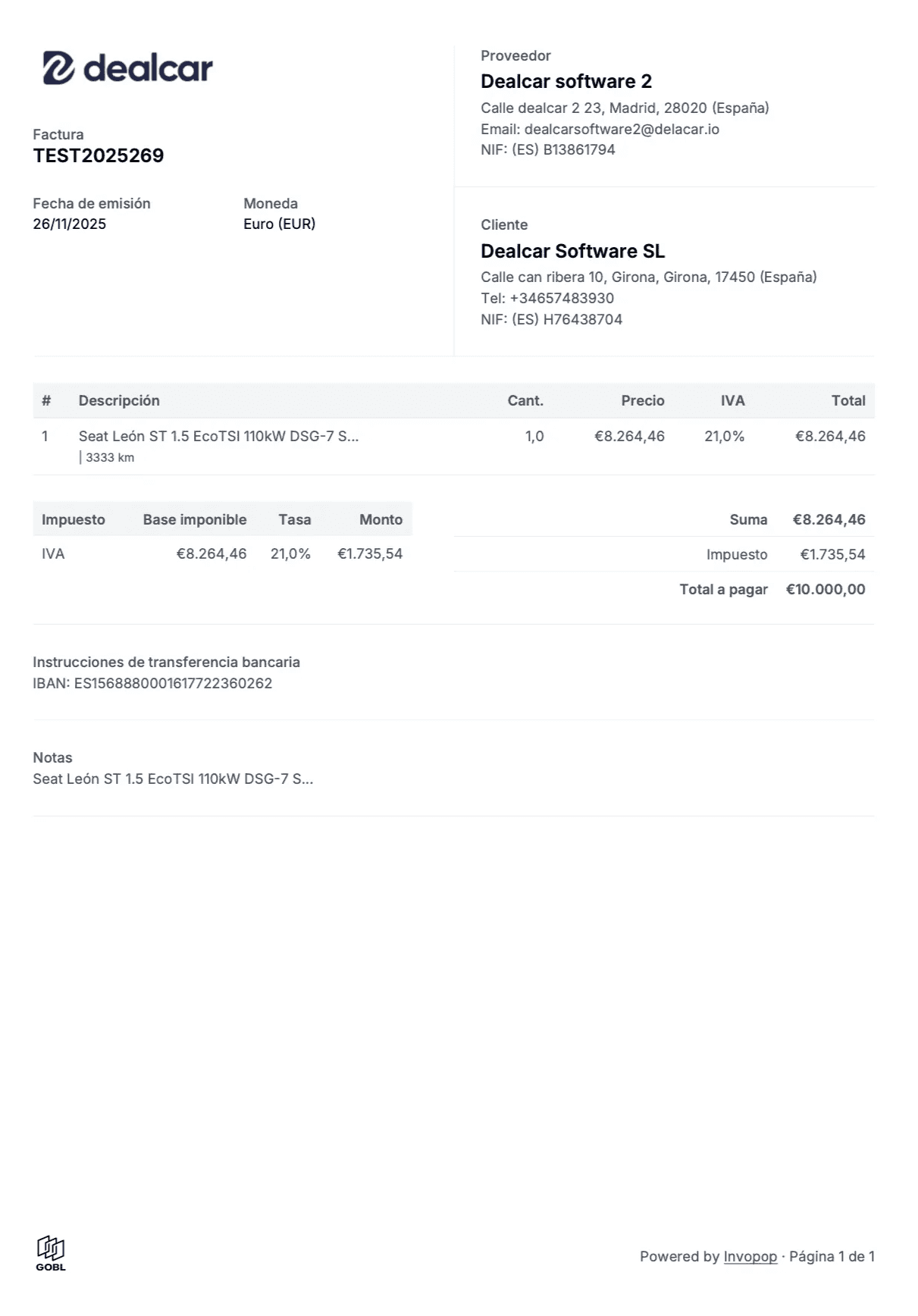
Invoice with VAT (Standard scheme)
It must show the taxable base and the VAT rate (normally 21%)
State "Transaction subject to and not exempt from VAT"
The buyer can deduct the VAT if they are a company or professional
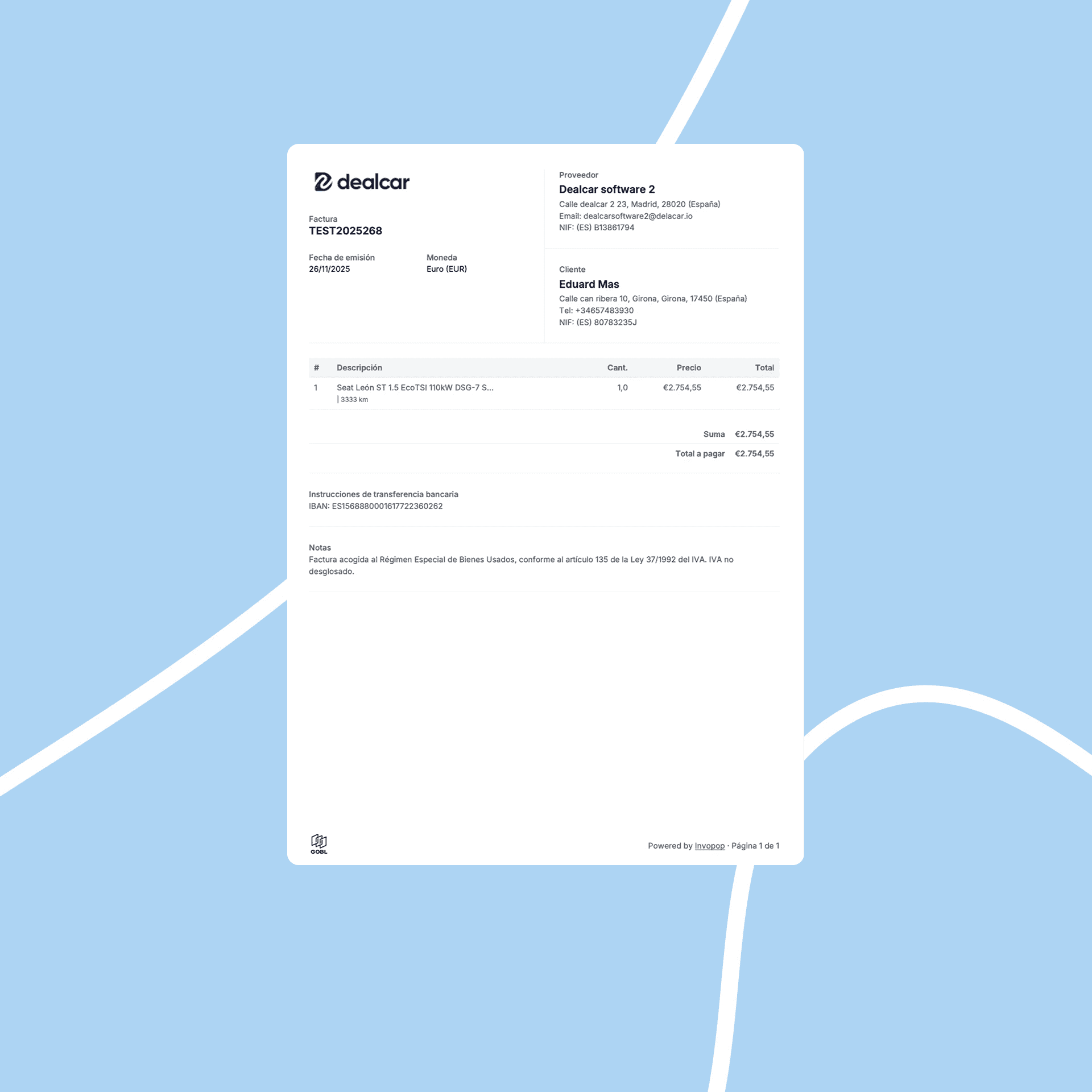
Invoice with REBU
VAT is not itemised
The following wording must be included:
"Special scheme for used goods. VAT included in the price. Not deductible."
The margin must be calculated internally in order to declare it correctly
Record book
You must keep:
Invoice issued ledger
Purchase ledger (if VAT applies)
REBU transactions ledger, if you use this scheme, including:
Purchase price
Sale price
Gross margin
VAT calculated on the margin (for declaration only, not on the invoice)
Practical invoicing examples
Invoice with VAT (sale to a company)
Invoice:
Base price: €10,000
VAT (21%): €2,100
Total invoice: €12,100
The buyer can deduct that VAT if they are a company.
Invoice with REBU (sale to a private individual)
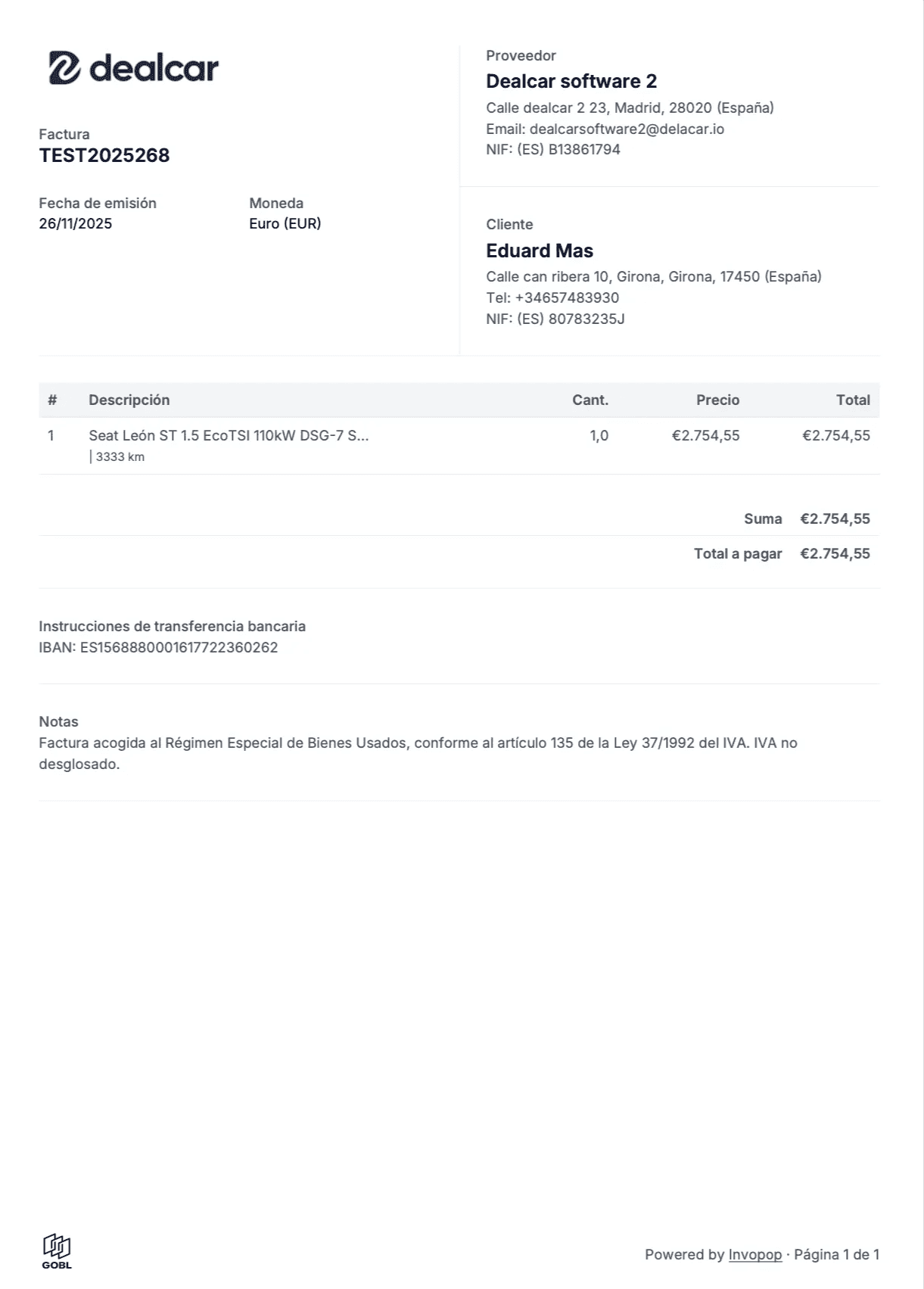
Invoice:
Sale price: €10,000 (VAT included on the margin)
Wording: "REBU. VAT included. Not deductible."
No VAT breakdown appears
Invoice for an imported car (intra-EU transaction)
If you apply REBU: the same as a purchase from a private individual
If you apply VAT: you must self-assess on form 303 and declare on form 349
Discover our complete REBU guide for more details.
Common mistakes when issuing invoices in buy-and-sell businesses
Confusing the tax scheme
Applying VAT when REBU should apply (and vice versa)
Using REBU for purchases with the right to deduct
Omitting mandatory details
Incomplete customer or vehicle details
Not stating the tax scheme
Incorrect invoice numbering
Declaring VAT incorrectly
Under REBU: VAT is calculated only on the margin
Declaring the total as the taxable base can cause errors and penalties
Using the same invoice for several transactions
Each vehicle must have its own invoice, with a unique identifier. Avoid grouped invoices.
Tips for dealers: professionalise your invoicing
Use tailored templates
Having specific templates for REBU and VAT avoids confusion and conveys professionalism. Dealcar offers ready-to-use templates.
Automate the process
If you have volume, consider using management or invoicing software that allows you to:
Generate automatic invoices
Keep a record of purchases and sales
Export data for filing tax returns
Consult your tax adviser
The combination of the standard scheme, REBU and intra-EU transactions requires professional attention to avoid mistakes and tax authority penalties.
Learn more about REBU
Do you have questions about how this special scheme works? Check out our complete REBU guide for dealers.
Conclusion
Issuing an invoice properly is not just about complying with the tax authorities, but also about demonstrating professionalism and protecting your business against possible claims. If you apply REBU correctly, declare your income clearly and use validated templates, you will be one step ahead of the competition.
At Dealcar we help you simplify your dealership's day-to-day management with tools, templates and up-to-date content for professionals like you. Check out our invoicing templates and take your business's tax control to the next level!
Issuing an invoice correctly in the buying and selling of used cars is not just a legal obligation: it is a guarantee of professionalism, transparency and tax security. If you are a dealer or a professional in the sector, this step-by-step guide will help you understand what type of invoice you should issue in each case, how to calculate VAT according to the applicable scheme (REBU or standard), what information it must contain and what mistakes you should avoid.
Who must issue an invoice in the buying and selling of used vehicles?
Professional dealers vs sales between private individuals
Only professional sellers (self-employed traders or companies dedicated to buying and selling) are required to issue an invoice. In sales between private individuals, no invoice is issued, but rather a private sale and purchase contract, and neither VAT nor REBU applies. For dealers, issuing an invoice is mandatory in all transactions.
Tax obligations of a buy-and-sell business
As a professional in the sector, you are required to:
Issue an invoice for every sale
Number and retain the invoices issued
Record transactions in the accounting books
Declare output VAT or the REBU margin in forms 303 and 390
Is it mandatory to issue an invoice if I sell to a private individual?
Yes. Even if the buyer is a private customer, the regulations require the professional seller to issue an invoice that correctly reflects the type of transaction and the tax scheme applied.
Types of invoicing according to the type of transaction
Sale with VAT (Standard scheme)
This scheme applies when the dealer acquires the vehicle from a company or another professional with the right to deduct VAT. In this case, VAT is calculated on the total sale price and itemised on the invoice. It is common in fleet, leasing or renting transactions.
Sale under REBU (Special Scheme for Used Goods)
REBU applies when the vehicle is acquired from a private individual or another professional who does not deduct VAT. In this case:
VAT is calculated on the margin (sale price - purchase price + associated non-deductible expenses)
It is not itemised on the invoice
Deduction of input VAT is not allowed
This scheme is the most common for dealers buying used cars from private individuals.
Intra-EU sale or import
If the car is bought in another EU country:
If the supplier is a company with an intra-EU VAT number, the reverse charge mechanism can be applied (no VAT on the invoice, but self-assessment on form 303)
If the supplier is a private individual, REBU can be applied
It is essential to declare the transaction correctly on form 349 and keep the transport documentation and taxes paid.
Special cases
Internal use or demonstrator vehicles: may generate VAT adjustments due to self-supply
Financed vehicles: the invoice shows the total price; financing is a separate contract
Renting or leasing with an option to buy: require specific tax treatment; they are not direct sales
How to make out an invoice correctly (step by step)
Mandatory details on every invoice
Full name or company name of the buyer and the seller
Tax ID/VAT number and registered address of both parties
Date of issue
Invoice number (sequential, with no gaps)
Detailed description of the vehicle (make, model, registration plate, chassis number, mileage, year of registration)
Net price, VAT (if applicable) or REBU margin
Payment method
Reference to the tax scheme (REBU, standard, exempt)
Invoice with VAT (Standard scheme)
It must show the taxable base and the VAT rate (normally 21%)
State "Transaction subject to and not exempt from VAT"
The buyer can deduct the VAT if they are a company or professional
Invoice with REBU
VAT is not itemised
The following wording must be included:
"Special scheme for used goods. VAT included in the price. Not deductible."
The margin must be calculated internally in order to declare it correctly
Record book
You must keep:
Invoice issued ledger
Purchase ledger (if VAT applies)
REBU transactions ledger, if you use this scheme, including:
Purchase price
Sale price
Gross margin
VAT calculated on the margin (for declaration only, not on the invoice)
Practical invoicing examples
Invoice with VAT (sale to a company)
Invoice:
Base price: €10,000
VAT (21%): €2,100
Total invoice: €12,100
The buyer can deduct that VAT if they are a company.
Invoice with REBU (sale to a private individual)
Invoice:
Sale price: €10,000 (VAT included on the margin)
Wording: "REBU. VAT included. Not deductible."
No VAT breakdown appears
Invoice for an imported car (intra-EU transaction)
If you apply REBU: the same as a purchase from a private individual
If you apply VAT: you must self-assess on form 303 and declare on form 349
Discover our complete REBU guide for more details.
Common mistakes when issuing invoices in buy-and-sell businesses
Confusing the tax scheme
Applying VAT when REBU should apply (and vice versa)
Using REBU for purchases with the right to deduct
Omitting mandatory details
Incomplete customer or vehicle details
Not stating the tax scheme
Incorrect invoice numbering
Declaring VAT incorrectly
Under REBU: VAT is calculated only on the margin
Declaring the total as the taxable base can cause errors and penalties
Using the same invoice for several transactions
Each vehicle must have its own invoice, with a unique identifier. Avoid grouped invoices.
Tips for dealers: professionalise your invoicing
Use tailored templates
Having specific templates for REBU and VAT avoids confusion and conveys professionalism. Dealcar offers ready-to-use templates.
Automate the process
If you have volume, consider using management or invoicing software that allows you to:
Generate automatic invoices
Keep a record of purchases and sales
Export data for filing tax returns
Consult your tax adviser
The combination of the standard scheme, REBU and intra-EU transactions requires professional attention to avoid mistakes and tax authority penalties.
Learn more about REBU
Do you have questions about how this special scheme works? Check out our complete REBU guide for dealers.
Conclusion
Issuing an invoice properly is not just about complying with the tax authorities, but also about demonstrating professionalism and protecting your business against possible claims. If you apply REBU correctly, declare your income clearly and use validated templates, you will be one step ahead of the competition.
At Dealcar we help you simplify your dealership's day-to-day management with tools, templates and up-to-date content for professionals like you. Check out our invoicing templates and take your business's tax control to the next level!