

Table of Contents
What is an ERP and what was it originally designed for
Why dealerships look for ERPs when they don't need one
Real difference between ERP, DMS and CRM in the automotive industry
What an ERP covers that a DMS does not
When does an ERP make sense for a dealership
For most car dealerships: which solution fits best
Dealcar and comprehensive management of the independent dealership
Frequently Asked Questions

What is an ERP and what was it originally designed for
ERP stands for Enterprise Resource Planning. It is software that integrates all of a company's processes into a single platform: accounting, finance, purchasing, production, inventory, human resources and sales.
The most well-known ERPs on the market are SAP, Oracle, Microsoft Dynamics and Sage. They are designed for organisations with multiple departments, complex processes and advanced reporting needs that cross-reference data from across the entire company. A car manufacturer, a logistics company with a hundred employees or a business group with several lines of business are the profiles for which this type of software was originally designed.
The cost of implementing a generalist ERP reflects that complexity: licensing, implementation consultancy and team training can represent investments of between €20,000 and €200,000 for a medium-sized company, with implementation processes lasting between 3 and 18 months.
Why dealerships look for ERPs when they don't need one
The search for "dealership ERP" usually stems from a very specific frustration: the owner has business data scattered across several tools that do not talk to each other. The stock is in an Excel spreadsheet, the leads in the portal email, the accounting with the agency and the documentation in physical folders. They want something to centralise everything.
Also read how to automate a car dealership without the need for an ERP.
That need is real. But the solution is not necessarily an ERP. The ERP centralises everything because it covers everything, including a huge amount of functionality that a dealership selling 20 or 50 cars a month will never use: production modules, project management, complex payroll, multi-currency accounting consolidation. This functionality comes at a cost, in terms of licences and complexity of use, which generates no value for the business paying for it.
What the dealership needs in most cases is not an ERP: it is an automotive-specialist DMS (Dealer Management System), which covers exactly the functions of the dealership business without the overhead of a generalist system.
Real difference between ERP, DMS and CRM in the automotive industry
The three terms are often used loosely in the industry. Here are the real differences.
Type | What it covers | Who it's for | Approximate cost |
|---|---|---|---|
ERP | Everything: accounting, HR, production, inventory, sales | Companies with multiple departments and complex processes | From €20,000 in implementation |
DMS | Everything specific to a dealership: stock, leads, files, billing, portals, agency | Dealerships and car sellers of any size | From £80-£150/month |
CRM | Only customer and lead management: follow-up, history, sales pipeline | Any business with a consultative sales process | From £30-£150/month |
The relationship between the three is one of partial inclusion: a well-designed DMS includes CRM as part of its features. An ERP can include both a DMS and a CRM, but it requires a specific configuration layer for the automotive sector that in many cases does not exist natively.
Check out the complete guide on what a DMS is in the automotive sector and what it should include.
What an ERP covers that a DMS does not
There are three areas where an ERP provides functionality that a standard DMS does not usually cover.
Fully integrated accounting is the first. An ERP has a complete accounting module with automatic entries, balance sheets, profit and loss statements and integrated tax generation. Most dealership DMSs record operations and generate invoices, but advanced analytical accounting is managed by the agency or external accounting software.
Management of multiple legal entities is the second. If a group has several companies (each sales point in a different LTD, for example), an ERP can consolidate the financial information of all of them. A DMS typically operates within a single entity.
Human resources management is the third. Payroll, attendance tracking, holidays and performance evaluation are functionalities that a DMS does not cover and that are integrated with the rest of the system in an ERP.
For an independent dealer with a single company, fewer than 10 employees and accounting delegated to an agency, these three areas are not relevant. For a group with 5 sales points, 50 employees and financial consolidation needs between companies, the balance begins to tip towards the ERP or towards an advanced DMS complemented with accounting software.
Check out why your dealership needs a CRM and how to choose it wisely.
When does an ERP make sense for a dealership
An ERP starts to make sense for an automotive business when at least three of these conditions are met simultaneously.
More than three sales points with separate legal entities that need common financial consolidation. A team of more than 20 people with integrated HR management needs. Complementary activities to the dealership that share resources with it: workshop, spare parts, vehicle rental, insurance. Need for integration with manufacturer or group systems that only have connectors with well-known ERPs. Monthly volume of over 200 cars with business reporting that requires cross-referencing data from multiple modules.
Also read how to open a second sales point in a dealership.
Below that threshold, investment in an ERP does not generate a proportional return. The implementation time, licensing cost and complexity of use of a generalist ERP far outweigh the value it provides compared to a specialist DMS.
For most car dealerships: which solution fits best
An independent dealer selling between 10 and 150 cars a month with a single company, fewer than 10 employees and accounting managed by an external agency does not need an ERP. What they need is a DMS specialised in the automotive sector that covers stock, leads, sales files, invoicing with margin schemes, multi-posting to portals, integrated agency management and their own website.
Check out which dealership software makes the most sense in Spain in 2026.
This combination resolves 95% of the operational problems that lead an owner to search for "dealership ERP" on Google. And it does so at a monthly cost of between £80 and £300, compared to the thousands of pounds for ERP implementation and maintenance.
The moment it makes sense to reconsider that decision is when the business has grown to the point where the management of multiple entities, accounting consolidation and human resources management require an integration that the DMS cannot provide. That moment comes much later than most owners anticipate when they start thinking about scaling.
Dealcar and comprehensive management of the independent dealership
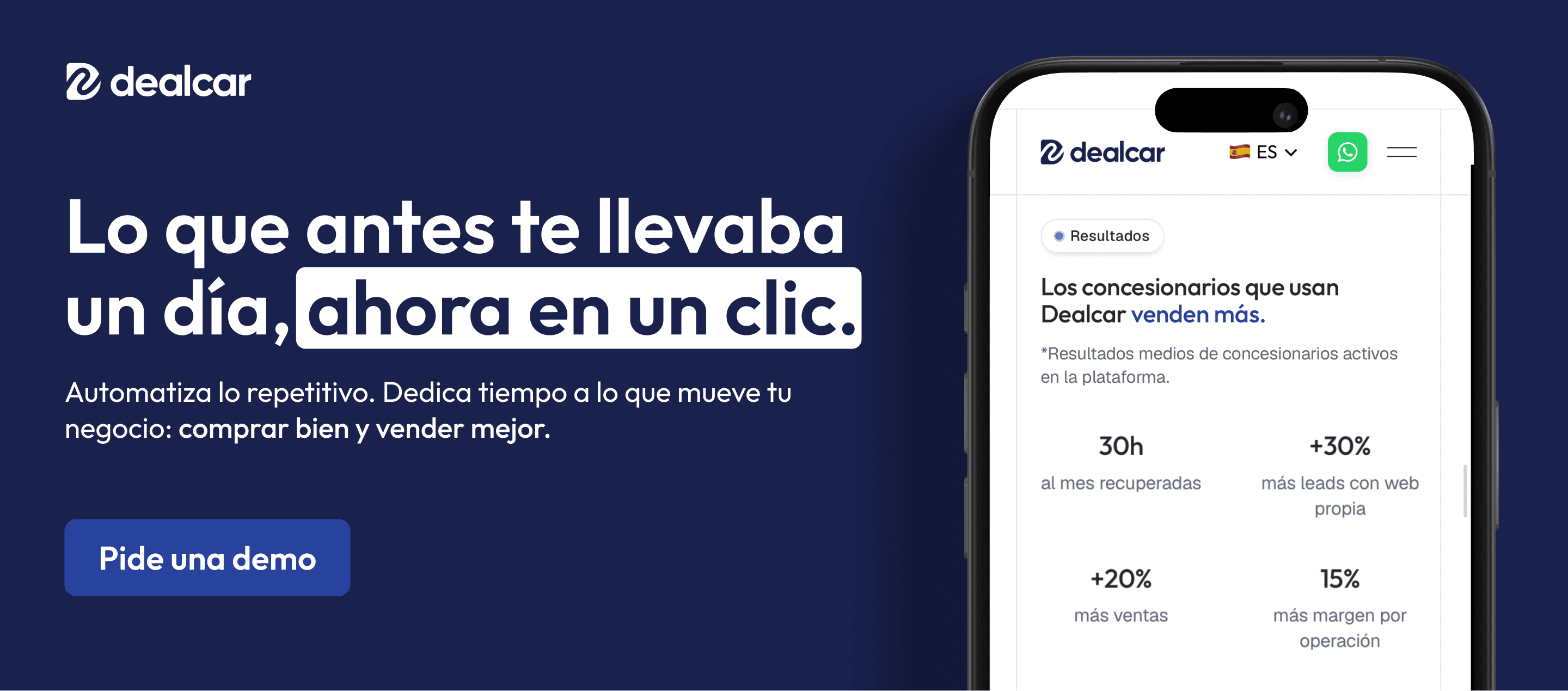
Dealcar is the DMS designed for the independent dealer who wants to have everything in one place: stock, leads, sales files, invoicing with margin schemes, multi-posting to portals, integrated agency management and a professional website with Blog Builder. AI agents automate repetitive tasks: generating ad descriptions, responding to leads out of hours and enhancing stock photos.
For most car dealerships, Dealcar covers what an ERP would cover for that specific business, without the complexity or implementation cost of a system designed for companies of another size.
Discover the features at dealcar.io/software-concesionario or request a demo at dealcar.io.
Frequently Asked Questions
Can an ERP manage used car stock?
Technically yes, but it requires a specific configuration of the inventory module to adapt it to the vehicle buying and selling cycle. That configuration does not exist natively in generalist ERPs: it has to be developed or purchased as an additional module. The result is often more complex and expensive than using a specialised DMS that has that logic built in from the start.
Can a DMS integrate with the agency's accounting software?
Most modern DMSs export operations in formats compatible with the main accounting programs (Contasol, Sage Contabilidad, A3). This allows the agency to work with its usual tools using the data exported from the DMS, without the need for an ERP that integrates accounting natively.
When is it worth migrating from a DMS to an ERP?
When the DMS starts to be the bottleneck for business growth, not the solution. The concrete signs are: the need to consolidate results from multiple legal entities, the integrated payroll management of more than 15 or 20 employees, or the requirement for integrations with corporate systems of a group or manufacturer that only support connectors with recognized ERPs.
What is the difference between SAP for Automotive and a DMS like Dealcar?
SAP has a specific module for vehicle distribution (SAP Vehicle Management) used by some large official dealership groups. It is designed for volumes of hundreds or thousands of cars per month, integration with OEM systems and complex corporate structures. The implementation cost exceeds £100,000 in most cases. For an independent dealer, SAP is overkill in every sense: price, complexity and features that will not be used.
Table of Contents
What is an ERP and what was it originally designed for
Why dealerships look for ERPs when they don't need one
Real difference between ERP, DMS and CRM in the automotive industry
What an ERP covers that a DMS does not
When does an ERP make sense for a dealership
For most car dealerships: which solution fits best
Dealcar and comprehensive management of the independent dealership
Frequently Asked Questions
What is an ERP and what was it originally designed for
ERP stands for Enterprise Resource Planning. It is software that integrates all of a company's processes into a single platform: accounting, finance, purchasing, production, inventory, human resources and sales.
The most well-known ERPs on the market are SAP, Oracle, Microsoft Dynamics and Sage. They are designed for organisations with multiple departments, complex processes and advanced reporting needs that cross-reference data from across the entire company. A car manufacturer, a logistics company with a hundred employees or a business group with several lines of business are the profiles for which this type of software was originally designed.
The cost of implementing a generalist ERP reflects that complexity: licensing, implementation consultancy and team training can represent investments of between €20,000 and €200,000 for a medium-sized company, with implementation processes lasting between 3 and 18 months.
Why dealerships look for ERPs when they don't need one
The search for "dealership ERP" usually stems from a very specific frustration: the owner has business data scattered across several tools that do not talk to each other. The stock is in an Excel spreadsheet, the leads in the portal email, the accounting with the agency and the documentation in physical folders. They want something to centralise everything.
Also read how to automate a car dealership without the need for an ERP.
That need is real. But the solution is not necessarily an ERP. The ERP centralises everything because it covers everything, including a huge amount of functionality that a dealership selling 20 or 50 cars a month will never use: production modules, project management, complex payroll, multi-currency accounting consolidation. This functionality comes at a cost, in terms of licences and complexity of use, which generates no value for the business paying for it.
What the dealership needs in most cases is not an ERP: it is an automotive-specialist DMS (Dealer Management System), which covers exactly the functions of the dealership business without the overhead of a generalist system.
Real difference between ERP, DMS and CRM in the automotive industry
The three terms are often used loosely in the industry. Here are the real differences.
Type | What it covers | Who it's for | Approximate cost |
|---|---|---|---|
ERP | Everything: accounting, HR, production, inventory, sales | Companies with multiple departments and complex processes | From €20,000 in implementation |
DMS | Everything specific to a dealership: stock, leads, files, billing, portals, agency | Dealerships and car sellers of any size | From £80-£150/month |
CRM | Only customer and lead management: follow-up, history, sales pipeline | Any business with a consultative sales process | From £30-£150/month |
The relationship between the three is one of partial inclusion: a well-designed DMS includes CRM as part of its features. An ERP can include both a DMS and a CRM, but it requires a specific configuration layer for the automotive sector that in many cases does not exist natively.
Check out the complete guide on what a DMS is in the automotive sector and what it should include.
What an ERP covers that a DMS does not
There are three areas where an ERP provides functionality that a standard DMS does not usually cover.
Fully integrated accounting is the first. An ERP has a complete accounting module with automatic entries, balance sheets, profit and loss statements and integrated tax generation. Most dealership DMSs record operations and generate invoices, but advanced analytical accounting is managed by the agency or external accounting software.
Management of multiple legal entities is the second. If a group has several companies (each sales point in a different LTD, for example), an ERP can consolidate the financial information of all of them. A DMS typically operates within a single entity.
Human resources management is the third. Payroll, attendance tracking, holidays and performance evaluation are functionalities that a DMS does not cover and that are integrated with the rest of the system in an ERP.
For an independent dealer with a single company, fewer than 10 employees and accounting delegated to an agency, these three areas are not relevant. For a group with 5 sales points, 50 employees and financial consolidation needs between companies, the balance begins to tip towards the ERP or towards an advanced DMS complemented with accounting software.
Check out why your dealership needs a CRM and how to choose it wisely.
When does an ERP make sense for a dealership
An ERP starts to make sense for an automotive business when at least three of these conditions are met simultaneously.
More than three sales points with separate legal entities that need common financial consolidation. A team of more than 20 people with integrated HR management needs. Complementary activities to the dealership that share resources with it: workshop, spare parts, vehicle rental, insurance. Need for integration with manufacturer or group systems that only have connectors with well-known ERPs. Monthly volume of over 200 cars with business reporting that requires cross-referencing data from multiple modules.
Also read how to open a second sales point in a dealership.
Below that threshold, investment in an ERP does not generate a proportional return. The implementation time, licensing cost and complexity of use of a generalist ERP far outweigh the value it provides compared to a specialist DMS.
For most car dealerships: which solution fits best
An independent dealer selling between 10 and 150 cars a month with a single company, fewer than 10 employees and accounting managed by an external agency does not need an ERP. What they need is a DMS specialised in the automotive sector that covers stock, leads, sales files, invoicing with margin schemes, multi-posting to portals, integrated agency management and their own website.
Check out which dealership software makes the most sense in Spain in 2026.
This combination resolves 95% of the operational problems that lead an owner to search for "dealership ERP" on Google. And it does so at a monthly cost of between £80 and £300, compared to the thousands of pounds for ERP implementation and maintenance.
The moment it makes sense to reconsider that decision is when the business has grown to the point where the management of multiple entities, accounting consolidation and human resources management require an integration that the DMS cannot provide. That moment comes much later than most owners anticipate when they start thinking about scaling.
Dealcar and comprehensive management of the independent dealership
Dealcar is the DMS designed for the independent dealer who wants to have everything in one place: stock, leads, sales files, invoicing with margin schemes, multi-posting to portals, integrated agency management and a professional website with Blog Builder. AI agents automate repetitive tasks: generating ad descriptions, responding to leads out of hours and enhancing stock photos.
For most car dealerships, Dealcar covers what an ERP would cover for that specific business, without the complexity or implementation cost of a system designed for companies of another size.
Discover the features at dealcar.io/software-concesionario or request a demo at dealcar.io.
Frequently Asked Questions
Can an ERP manage used car stock?
Technically yes, but it requires a specific configuration of the inventory module to adapt it to the vehicle buying and selling cycle. That configuration does not exist natively in generalist ERPs: it has to be developed or purchased as an additional module. The result is often more complex and expensive than using a specialised DMS that has that logic built in from the start.
Can a DMS integrate with the agency's accounting software?
Most modern DMSs export operations in formats compatible with the main accounting programs (Contasol, Sage Contabilidad, A3). This allows the agency to work with its usual tools using the data exported from the DMS, without the need for an ERP that integrates accounting natively.
When is it worth migrating from a DMS to an ERP?
When the DMS starts to be the bottleneck for business growth, not the solution. The concrete signs are: the need to consolidate results from multiple legal entities, the integrated payroll management of more than 15 or 20 employees, or the requirement for integrations with corporate systems of a group or manufacturer that only support connectors with recognized ERPs.
What is the difference between SAP for Automotive and a DMS like Dealcar?
SAP has a specific module for vehicle distribution (SAP Vehicle Management) used by some large official dealership groups. It is designed for volumes of hundreds or thousands of cars per month, integration with OEM systems and complex corporate structures. The implementation cost exceeds £100,000 in most cases. For an independent dealer, SAP is overkill in every sense: price, complexity and features that will not be used.


