

Index
Who is obliged to issue an invoice
The two key documents: purchase invoice and sales invoice
Invoice with general VAT: when and how to issue it
Invoice with REBU (Second-Hand Goods Scheme): when and how to issue it
Complete numerical example: the same transaction with VAT and with REBU
Mandatory data in every vehicle purchase and sale invoice
Simplified invoice vs full invoice
Intra-Community transactions and imports
Verifactu and electronic invoicing: what is coming in 2026-2027
Mandatory registry books
Frequent mistakes when invoicing in buying and selling
Conclusion
Frequently asked questions

Invoicing is probably the most delicate part of the administrative management of a used car dealership. Not only because the Tax Agency can penalise an incorrectly issued invoice, but because the invoice is the document that supports the entire operation: the purchase, the sale, the tax scheme applied, the margin obtained and the relationship with the client.
The problem is that many dealerships work with two tax schemes at the same time (REBU and general VAT), buy from individuals and companies, sell to final consumers and professionals, and in some cases operate with imported vehicles. Each combination requires a different type of invoice, with a different format and legal mentions.
This article explains step by step which invoice to issue in each case, with numerical examples, the details that must not be missed and the most common mistakes to avoid. In addition, we include the updates on Verifactu and the mandatory electronic invoice that affect all dealerships from 2026.
Who is obliged to issue an invoice
Every professional seller (self-employed or company) dedicated to the purchase and sale of vehicles is obliged to issue an invoice in each sales operation, without exception. It does not matter if the buyer is an individual, a company or a self-employed person: the obligation falls on the professional seller.
In sales between individuals, no invoice is issued. The transaction is formalised through a private purchase and sale agreement and the buyer pays the Property Transfer Tax (ITP). If you want to know more about when this tax applies, we explain it in our article on what is ITP in car sales.
As a professional, in addition to issuing an invoice you are obliged to number the invoices consecutively (without gaps), keep them for a minimum of 4 years (6 if there are intra-Community transactions), register each transaction in the corresponding accounting books and declare the output VAT or the REBU margin in the quarterly (303) and annual (390) forms.
The two key documents: purchase invoice and sales invoice
This is a point that many dealerships neglect. You must not only issue an invoice when you sell: you also need to correctly document the purchase.
Sales invoice. This is the one you issue to the buyer (individual or professional) when you sell a car. It can be with itemised VAT (general scheme) or without itemisation (REBU). It is the main document of the operation.
Purchase document from an individual (buyer's invoice or purchase receipt). When you buy a car from an individual, they do not issue you an invoice (they are not a professional). Instead, the dealership issues a purchase document (sometimes called a buyer's invoice) that collects the data of the individual seller, the vehicle data, the price paid and the signature of both parties. This document is essential to prove that the purchase was made from an individual without deductible VAT and, therefore, that you can apply REBU when reselling.
Without this document, the Tax Agency may consider that you have no basis to access the REBU scheme and recalculate the VAT on the total price of the sale. It is one of the most important documents in the file of each car.
Purchase invoice from a professional. If you buy the car from a company, fleet or renting business, you receive an invoice with itemised VAT. In that case, you deduct the input VAT and when reselling you apply the general scheme.
Invoice with general VAT: when and how to issue it
The general scheme is applied when the dealership has bought the car from a supplier who issued an invoice with itemised VAT and has deducted that VAT on the purchase.
When it applies: purchases from renting companies (LeasePlan, ALD, Arval), corporate fleets, other dealerships in the general scheme or intra-Community suppliers with a VAT number.
How the invoice is issued:
The invoice must reflect the base price of the vehicle (excluding VAT), the type of VAT applied (21% as a general rule) with the itemised amount and the total price (base + VAT). It is advisable to include the mention "Transaction subject to and not exempt from VAT" to make the applied scheme clear.
The buyer, if a company or professional, can deduct the VAT from this invoice in their quarterly declaration. If the buyer is an individual, they pay the total price but cannot deduct anything.
To understand in detail when to apply each scheme, we recommend our article on when to use an invoice with VAT and when with REBU.
Invoice with REBU: when and how to issue it
The Special Scheme for Second-Hand Goods (REBU) allows taxing only on the profit margin, not on the total price. It is the most common scheme in the buying and selling of used cars to final consumers.
When it applies: purchases from individuals, trade-ins, purchases from other dealerships that also sold under REBU (without itemised VAT on their invoice).
How the invoice is issued:
The invoice shows a single final price, without itemised VAT. No taxable base or VAT amount appears separately. It must obligatorily include the legal legend: "Régimen especial de bienes usados. IVA incluido en el precio. Sin derecho a deducción por el adquirente." (Special scheme for second-hand goods. VAT included in the price. No right of deduction for the purchaser.)
Internally, the dealership calculates the VAT on the margin (selling price minus purchase price) and declares it in form 303. But that calculation does not appear on the invoice the customer receives.
If you want to go deeper into the complete operation of REBU, we explain it in our complete guide on REBU in the buying and selling of second-hand cars.
Complete numerical example: the same transaction with VAT and with REBU
To see the real difference, let's take a car that the dealership buys for 8,000 euros and sells for 10,500 euros. Gross margin: 2,500 euros.
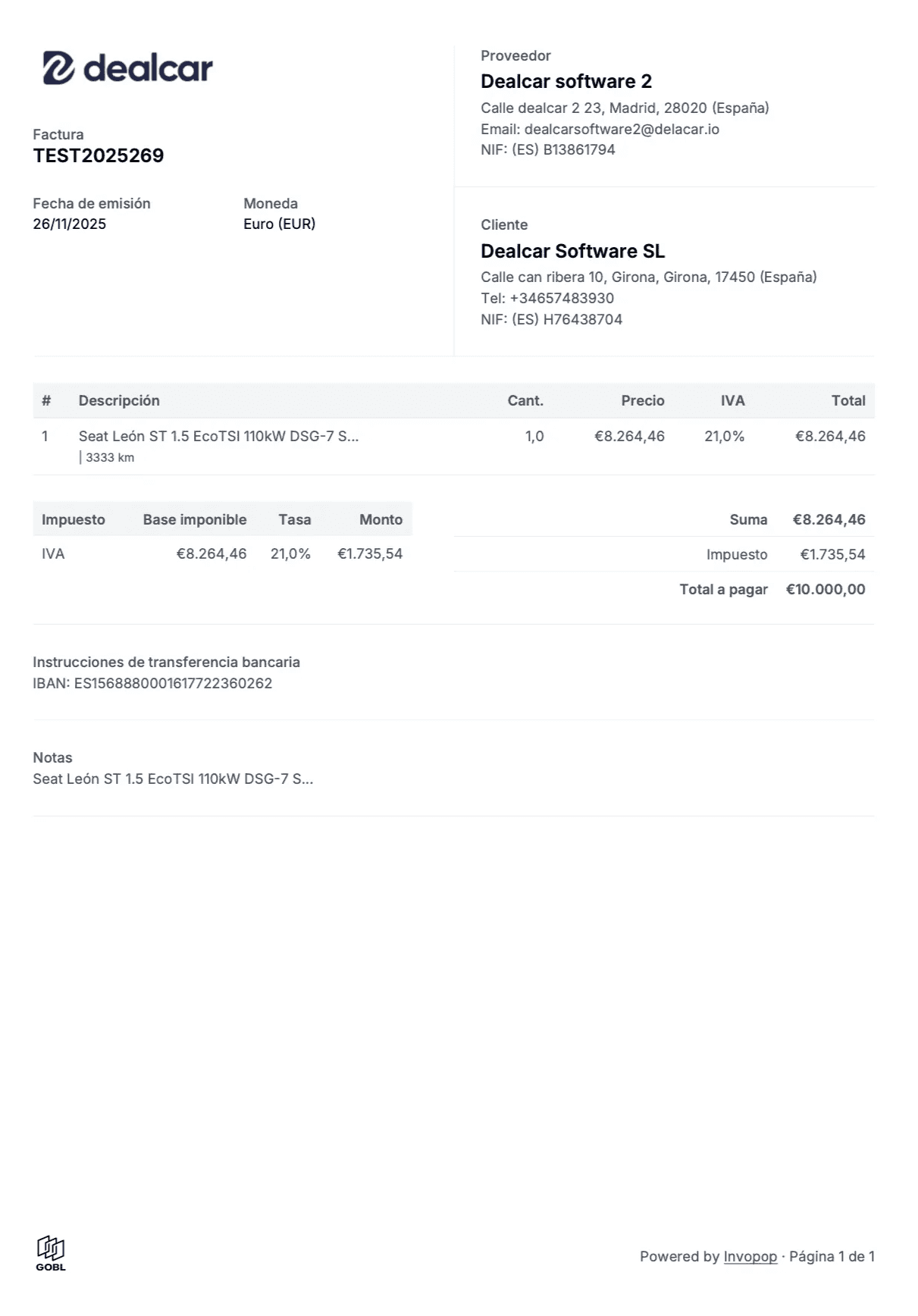
With general VAT (21%):
The dealership bought with an invoice with VAT (the input VAT was deducted). When selling, it charges 21% on the total price.
Base price of sale: 10,500 euros. Charged VAT (21%): 2,205 euros. Total that the buyer pays: 12,705 euros.
The dealership pays the Tax Agency the difference between charged VAT (2,205 euros) and the input VAT on the purchase. If they paid 8,000 euros + 21% VAT (1,680 euros), the net VAT to pay would be 2,205 - 1,680 = 525 euros.
With REBU:
The dealership bought from an individual (without deductible VAT). When selling, it taxes only on the margin.
Price that the buyer pays: 10,500 euros (VAT included in the margin). The gross margin is 10,500 - 8,000 = 2,500 euros. The taxable base of the VAT is 2,500 / 1.21 = 2,066.12 euros. The VAT to pay is 2,500 - 2,066.12 = 433.88 euros.
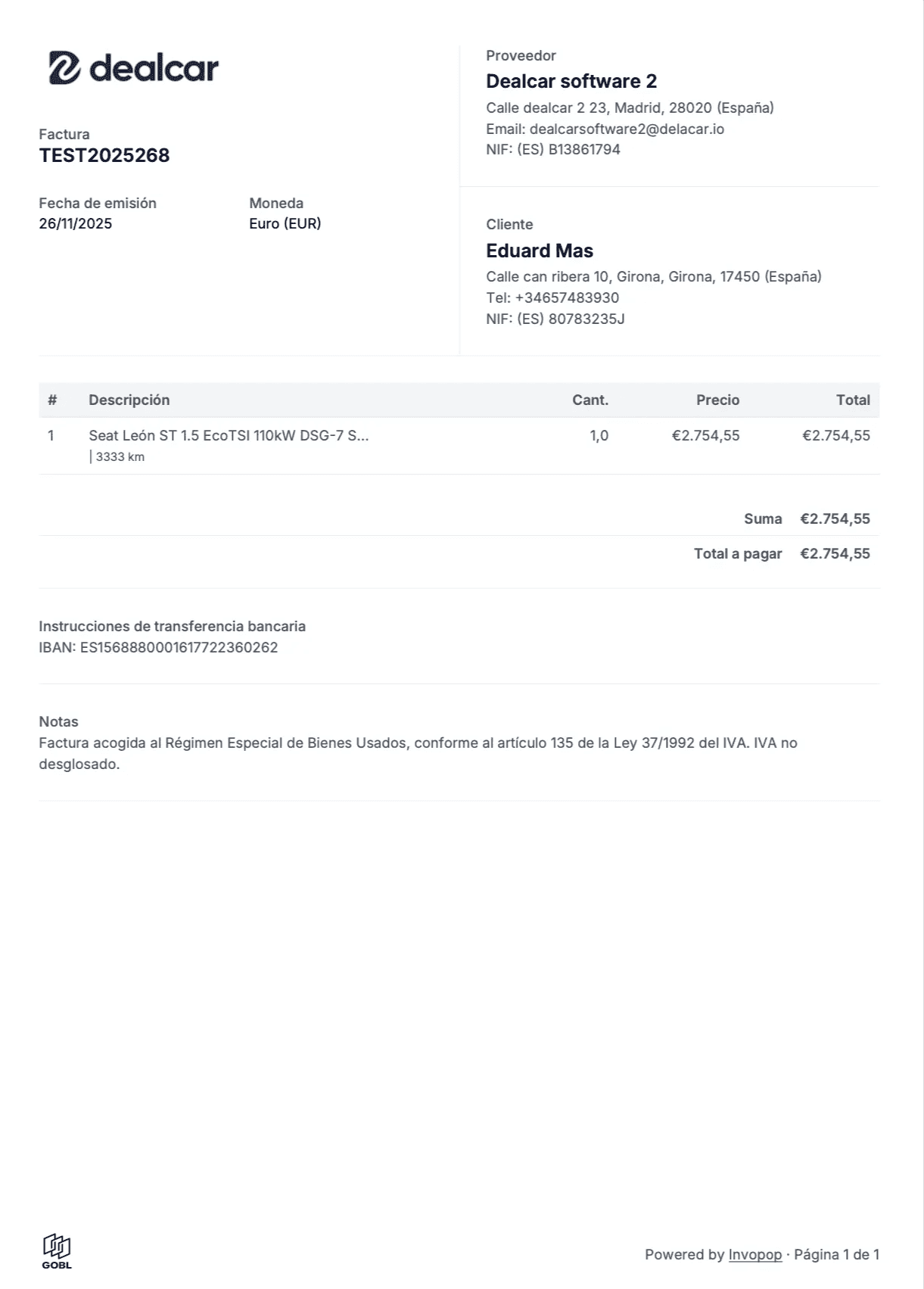
Difference for the individual buyer: with general VAT they pay 12,705 euros. With REBU they pay 10,500 euros. That is a 2,205 euro difference. This is why REBU is so relevant in sales to final consumers.
Difference for the dealership: with general VAT they pay 525 euros of net VAT. With REBU they pay 433.88 euros. The difference is smaller, but the more competitive final price of REBU facilitates the sale.
Mandatory data in every vehicle purchase and sale invoice
Regardless of the tax scheme, every sales invoice of a vehicle must contain:
Seller details: full name or company name, tax ID (NIF/CIF) and registered tax office address.
Buyer details: full name or company name, tax ID (NIF/CIF) and registered tax office address.
Invoice details: consecutive number (no gaps in the numbering), date of issue and series (if you use several series).
Vehicle details: make, model, version, chassis number (VIN), registration plate, date of first registration, mileage and colour. The more detailed the description, the better protected you are against claims.
Economic details: selling price, itemised VAT (if applicable) or mention of REBU, method of payment and mention of the applied tax scheme.
A common mistake is not including the chassis number or mileage. In the event of a subsequent claim, an invoice with incomplete vehicle details weakens the dealership's position.
Simplified invoice vs full invoice
In the transaction of buying and selling vehicles, the general rule is to always issue a full invoice. The simplified invoice (what used to be called a "receipt" or "ticket") is only allowed when the amount does not exceed 400 euros (or 3,000 euros in certain activities), which in practice means it does not apply to car sales.
However, you can use a simplified invoice for small-amount complementary services (cleaning, accessories, etc.) if they do not exceed the limits. For the sale of the vehicle itself, always a full invoice.
Intra-Community transactions and imports
If you buy cars in other EU countries, invoicing has its specifics:
Purchase from a company with an intra-Community VAT ID. Reverse charge applies: the supplier does not charge you VAT. You self-assess the VAT in Spain (form 303) and declare it in form 349 for intra-Community operations. When reselling, you invoice with general VAT.
Purchase from an individual in another EU country. If you buy directly from an individual in Germany, France or another country, you can apply REBU when reselling in Spain, since the seller has not charged you VAT. You need to keep the purchase and sale contract and transport documentation.
Import from outside the EU. You must settle the import VAT at customs. When reselling, you apply the general scheme.
In all cases, keep transport documentation, payment receipts and customs declarations. These are the documents the Tax Agency will request in the event of an inspection. If you are considering importing, we recommend our article on how to import a second-hand car.
Verifactu and electronic invoicing: what is coming in 2026-2027
This is a topic that directly affects all dealerships and is worth keeping on the radar.
Verifactu is the new invoice verification system promoted by the Anti-Fraud Law (Law 11/2021). It obliges all invoicing software to guarantee the traceability, integrity and inalterability of each invoice issued. In practice, this means that the programme you use for invoicing must be certified and generate a verifiable digital record (with a QR code and electronic signature) that the Tax Agency can check.
Verifactu deadlines: companies (legal entities) were required to use certified software starting January 2026, with a moratorium applied in late 2025 that adjusted the calendar. Self-employed individuals have until July 2026-2027 depending on the case. Following the moratorium, full compliance is expected to be effectively required throughout 2026.
Mandatory electronic invoicing (B2B): in addition to Verifactu, the Crea y Crece Law establishes mandatory electronic invoicing between companies and professionals. Royal Decree 238/2026 (approved in March 2026) has developed the system. Companies with a turnover of more than 8 million euros must comply starting October 2027, and the rest of companies and self-employed from October 2028.
Sanctions: using non-certified invoicing software can lead to fines of up to 50,000 euros per tax year.
What this means for a dealership: if you invoice using Excel, Word templates or a programme that is not prepared for Verifactu, you need to change before sanctions are applied. The transition is not complicated if you use a platform that already complies with the regulations, but it requires acting in advance.
Mandatory registry books
In addition to invoices, as a dealership you must maintain several registry books:
Issued invoices registry book. All sales invoices, both REBU and general VAT.
Received invoices registry book. Purchase invoices from professional suppliers (with deductible VAT).
REBU transactions registry book. Mandatory and separate from the general book. It must include for each transaction: date, details of the individual seller, vehicle description (make, model, registration plate), purchase price, selling price, gross margin and VAT calculated on the margin (for the tax declaration, not for the invoice).
Investment goods book. If you have assets linked to the activity for more than 300 euros.
Keeping these records up to date is not optional. In the event of an inspection, the Tax Agency requests them and compares them with the declarations submitted. Any discrepancy can generate a request.
If you want to understand the complete taxation of a dealership, we explain it in our guide on how to pay taxes correctly as a car dealer.
Frequent mistakes when invoicing in buying and selling
Applying REBU when the car was bought with deductible VAT. If you deducted VAT on the purchase, you cannot apply REBU when selling. It is incompatible. The Tax Agency can claim the difference plus a 50-150% penalty of the quota.
Not keeping the purchase document from an individual. Without the purchase receipt signed by the individual, you lose the basis to justify REBU. And without justification, the Tax Agency can recalculate the VAT on the total price.
Itemising VAT on a REBU invoice. Serious mistake. A REBU invoice does not have itemised VAT. Including it invalides the transaction fiscally and can lead the buyer to believe they can deduct it.
Omitting the legal mention of REBU. Every REBU invoice must bear the mandatory legend. Omitting it is a cause for inspection and can call into question the validity of the invoice.
Numbering with gaps. Invoices must be consecutive, without gaps. If the previous invoice was 2025/047, the next one must be 2025/048. Gaps generate automatic alerts in the Tax Agency.
Not including the chassis number. In the buying and selling of vehicles, the chassis is the unique identifier of the car. An invoice without a chassis number loses traceability and weakens your position against any claim.
Grouping several cars in a single invoice. Each vehicle must have its own invoice with unique identification. Grouped invoices make it difficult to control the margin and can generate tax problems.
If you want to see the most common mistakes with REBU in detail, consult our article on common mistakes when applying REBU in dealerships.
Conclusion
Issuing invoices correctly is not just about complying with the Tax Agency: it is about protecting your business against claims, keeping the margin controlled and being able to scale without tax surprises. The key lies in classifying each transaction from the purchase (REBU or general), properly documenting purchase receipts from individuals, issuing invoices with the correct data and legal mentions and keeping the registry books up to date. With the arrival of Verifactu and mandatory electronic invoicing, doing so with a prepared system is no longer an option: it is a necessity.
More than 500 dealerships already use Dealcar to manage their invoicing without errors. From the platform, you can classify each transaction as REBU or general VAT from the purchase, generate automatic invoices with the correct legal format (including the REBU mention), keep the registry book updated and prepare for Verifactu with a system that is already certified. If you want to see how it works, you can learn about Dealcar's electronic invoicing module.
Frequently asked questions
Is it mandatory to issue an invoice if I sell a car to an individual?
Yes. Every professional seller (self-employed or company) is obliged to issue an invoice in each transaction, regardless of whether the buyer is an individual or a company. The invoice can be REBU (without itemised VAT) or with general VAT, depending on the origin of the car.
What document do I need when I buy a car from an individual?
A purchase receipt (or buyer's invoice) that collects the full details of the individual seller (ID, name, address), the vehicle details (make, model, registration plate, chassis), the price paid and the signature of both parties. This document proves that the purchase was made without deductible VAT and allows applying REBU when reselling.
Can I use a simplified invoice (receipt) to sell a car?
In practice, no. The simplified invoice is limited to amounts of up to 400 euros (or 3,000 euros in authorised activities). Since the price of a vehicle always exceeds those amounts, you must issue a full invoice with all the mandatory details.
What happens if I make a mistake on an already issued invoice?
You must issue a corrective invoice that refers to the original invoice (number and date), describes the error and reflects the correction. You cannot simply cancel and reissue with the same number. The corrective invoice has its own numbering.
How does Verifactu affect me as a dealership?
From 2026, your invoicing software must be certified for Verifactu: each invoice must be traceable, inalterable and verifiable with a QR code. If you continue invoicing with Excel or Word, you need to migrate to a compatible system before sanctions are applied (up to 50,000 euros per year). Dealcar already meets Verifactu's requirements.
Can I keep REBU transactions and general VAT ones in the same registry book?
No. Regulations require a REBU transactions registry book separate from the general invoice book. You can use the same software, but the records must be differentiated and contain specific information for each scheme.
Index
Who is obliged to issue an invoice
The two key documents: purchase invoice and sales invoice
Invoice with general VAT: when and how to issue it
Invoice with REBU (Second-Hand Goods Scheme): when and how to issue it
Complete numerical example: the same transaction with VAT and with REBU
Mandatory data in every vehicle purchase and sale invoice
Simplified invoice vs full invoice
Intra-Community transactions and imports
Verifactu and electronic invoicing: what is coming in 2026-2027
Mandatory registry books
Frequent mistakes when invoicing in buying and selling
Conclusion
Frequently asked questions
Invoicing is probably the most delicate part of the administrative management of a used car dealership. Not only because the Tax Agency can penalise an incorrectly issued invoice, but because the invoice is the document that supports the entire operation: the purchase, the sale, the tax scheme applied, the margin obtained and the relationship with the client.
The problem is that many dealerships work with two tax schemes at the same time (REBU and general VAT), buy from individuals and companies, sell to final consumers and professionals, and in some cases operate with imported vehicles. Each combination requires a different type of invoice, with a different format and legal mentions.
This article explains step by step which invoice to issue in each case, with numerical examples, the details that must not be missed and the most common mistakes to avoid. In addition, we include the updates on Verifactu and the mandatory electronic invoice that affect all dealerships from 2026.
Who is obliged to issue an invoice
Every professional seller (self-employed or company) dedicated to the purchase and sale of vehicles is obliged to issue an invoice in each sales operation, without exception. It does not matter if the buyer is an individual, a company or a self-employed person: the obligation falls on the professional seller.
In sales between individuals, no invoice is issued. The transaction is formalised through a private purchase and sale agreement and the buyer pays the Property Transfer Tax (ITP). If you want to know more about when this tax applies, we explain it in our article on what is ITP in car sales.
As a professional, in addition to issuing an invoice you are obliged to number the invoices consecutively (without gaps), keep them for a minimum of 4 years (6 if there are intra-Community transactions), register each transaction in the corresponding accounting books and declare the output VAT or the REBU margin in the quarterly (303) and annual (390) forms.
The two key documents: purchase invoice and sales invoice
This is a point that many dealerships neglect. You must not only issue an invoice when you sell: you also need to correctly document the purchase.
Sales invoice. This is the one you issue to the buyer (individual or professional) when you sell a car. It can be with itemised VAT (general scheme) or without itemisation (REBU). It is the main document of the operation.
Purchase document from an individual (buyer's invoice or purchase receipt). When you buy a car from an individual, they do not issue you an invoice (they are not a professional). Instead, the dealership issues a purchase document (sometimes called a buyer's invoice) that collects the data of the individual seller, the vehicle data, the price paid and the signature of both parties. This document is essential to prove that the purchase was made from an individual without deductible VAT and, therefore, that you can apply REBU when reselling.
Without this document, the Tax Agency may consider that you have no basis to access the REBU scheme and recalculate the VAT on the total price of the sale. It is one of the most important documents in the file of each car.
Purchase invoice from a professional. If you buy the car from a company, fleet or renting business, you receive an invoice with itemised VAT. In that case, you deduct the input VAT and when reselling you apply the general scheme.
Invoice with general VAT: when and how to issue it
The general scheme is applied when the dealership has bought the car from a supplier who issued an invoice with itemised VAT and has deducted that VAT on the purchase.
When it applies: purchases from renting companies (LeasePlan, ALD, Arval), corporate fleets, other dealerships in the general scheme or intra-Community suppliers with a VAT number.
How the invoice is issued:
The invoice must reflect the base price of the vehicle (excluding VAT), the type of VAT applied (21% as a general rule) with the itemised amount and the total price (base + VAT). It is advisable to include the mention "Transaction subject to and not exempt from VAT" to make the applied scheme clear.
The buyer, if a company or professional, can deduct the VAT from this invoice in their quarterly declaration. If the buyer is an individual, they pay the total price but cannot deduct anything.
To understand in detail when to apply each scheme, we recommend our article on when to use an invoice with VAT and when with REBU.
Invoice with REBU: when and how to issue it
The Special Scheme for Second-Hand Goods (REBU) allows taxing only on the profit margin, not on the total price. It is the most common scheme in the buying and selling of used cars to final consumers.
When it applies: purchases from individuals, trade-ins, purchases from other dealerships that also sold under REBU (without itemised VAT on their invoice).
How the invoice is issued:
The invoice shows a single final price, without itemised VAT. No taxable base or VAT amount appears separately. It must obligatorily include the legal legend: "Régimen especial de bienes usados. IVA incluido en el precio. Sin derecho a deducción por el adquirente." (Special scheme for second-hand goods. VAT included in the price. No right of deduction for the purchaser.)
Internally, the dealership calculates the VAT on the margin (selling price minus purchase price) and declares it in form 303. But that calculation does not appear on the invoice the customer receives.
If you want to go deeper into the complete operation of REBU, we explain it in our complete guide on REBU in the buying and selling of second-hand cars.
Complete numerical example: the same transaction with VAT and with REBU
To see the real difference, let's take a car that the dealership buys for 8,000 euros and sells for 10,500 euros. Gross margin: 2,500 euros.
With general VAT (21%):
The dealership bought with an invoice with VAT (the input VAT was deducted). When selling, it charges 21% on the total price.
Base price of sale: 10,500 euros. Charged VAT (21%): 2,205 euros. Total that the buyer pays: 12,705 euros.
The dealership pays the Tax Agency the difference between charged VAT (2,205 euros) and the input VAT on the purchase. If they paid 8,000 euros + 21% VAT (1,680 euros), the net VAT to pay would be 2,205 - 1,680 = 525 euros.
With REBU:
The dealership bought from an individual (without deductible VAT). When selling, it taxes only on the margin.
Price that the buyer pays: 10,500 euros (VAT included in the margin). The gross margin is 10,500 - 8,000 = 2,500 euros. The taxable base of the VAT is 2,500 / 1.21 = 2,066.12 euros. The VAT to pay is 2,500 - 2,066.12 = 433.88 euros.
Difference for the individual buyer: with general VAT they pay 12,705 euros. With REBU they pay 10,500 euros. That is a 2,205 euro difference. This is why REBU is so relevant in sales to final consumers.
Difference for the dealership: with general VAT they pay 525 euros of net VAT. With REBU they pay 433.88 euros. The difference is smaller, but the more competitive final price of REBU facilitates the sale.
Mandatory data in every vehicle purchase and sale invoice
Regardless of the tax scheme, every sales invoice of a vehicle must contain:
Seller details: full name or company name, tax ID (NIF/CIF) and registered tax office address.
Buyer details: full name or company name, tax ID (NIF/CIF) and registered tax office address.
Invoice details: consecutive number (no gaps in the numbering), date of issue and series (if you use several series).
Vehicle details: make, model, version, chassis number (VIN), registration plate, date of first registration, mileage and colour. The more detailed the description, the better protected you are against claims.
Economic details: selling price, itemised VAT (if applicable) or mention of REBU, method of payment and mention of the applied tax scheme.
A common mistake is not including the chassis number or mileage. In the event of a subsequent claim, an invoice with incomplete vehicle details weakens the dealership's position.
Simplified invoice vs full invoice
In the transaction of buying and selling vehicles, the general rule is to always issue a full invoice. The simplified invoice (what used to be called a "receipt" or "ticket") is only allowed when the amount does not exceed 400 euros (or 3,000 euros in certain activities), which in practice means it does not apply to car sales.
However, you can use a simplified invoice for small-amount complementary services (cleaning, accessories, etc.) if they do not exceed the limits. For the sale of the vehicle itself, always a full invoice.
Intra-Community transactions and imports
If you buy cars in other EU countries, invoicing has its specifics:
Purchase from a company with an intra-Community VAT ID. Reverse charge applies: the supplier does not charge you VAT. You self-assess the VAT in Spain (form 303) and declare it in form 349 for intra-Community operations. When reselling, you invoice with general VAT.
Purchase from an individual in another EU country. If you buy directly from an individual in Germany, France or another country, you can apply REBU when reselling in Spain, since the seller has not charged you VAT. You need to keep the purchase and sale contract and transport documentation.
Import from outside the EU. You must settle the import VAT at customs. When reselling, you apply the general scheme.
In all cases, keep transport documentation, payment receipts and customs declarations. These are the documents the Tax Agency will request in the event of an inspection. If you are considering importing, we recommend our article on how to import a second-hand car.
Verifactu and electronic invoicing: what is coming in 2026-2027
This is a topic that directly affects all dealerships and is worth keeping on the radar.
Verifactu is the new invoice verification system promoted by the Anti-Fraud Law (Law 11/2021). It obliges all invoicing software to guarantee the traceability, integrity and inalterability of each invoice issued. In practice, this means that the programme you use for invoicing must be certified and generate a verifiable digital record (with a QR code and electronic signature) that the Tax Agency can check.
Verifactu deadlines: companies (legal entities) were required to use certified software starting January 2026, with a moratorium applied in late 2025 that adjusted the calendar. Self-employed individuals have until July 2026-2027 depending on the case. Following the moratorium, full compliance is expected to be effectively required throughout 2026.
Mandatory electronic invoicing (B2B): in addition to Verifactu, the Crea y Crece Law establishes mandatory electronic invoicing between companies and professionals. Royal Decree 238/2026 (approved in March 2026) has developed the system. Companies with a turnover of more than 8 million euros must comply starting October 2027, and the rest of companies and self-employed from October 2028.
Sanctions: using non-certified invoicing software can lead to fines of up to 50,000 euros per tax year.
What this means for a dealership: if you invoice using Excel, Word templates or a programme that is not prepared for Verifactu, you need to change before sanctions are applied. The transition is not complicated if you use a platform that already complies with the regulations, but it requires acting in advance.
Mandatory registry books
In addition to invoices, as a dealership you must maintain several registry books:
Issued invoices registry book. All sales invoices, both REBU and general VAT.
Received invoices registry book. Purchase invoices from professional suppliers (with deductible VAT).
REBU transactions registry book. Mandatory and separate from the general book. It must include for each transaction: date, details of the individual seller, vehicle description (make, model, registration plate), purchase price, selling price, gross margin and VAT calculated on the margin (for the tax declaration, not for the invoice).
Investment goods book. If you have assets linked to the activity for more than 300 euros.
Keeping these records up to date is not optional. In the event of an inspection, the Tax Agency requests them and compares them with the declarations submitted. Any discrepancy can generate a request.
If you want to understand the complete taxation of a dealership, we explain it in our guide on how to pay taxes correctly as a car dealer.
Frequent mistakes when invoicing in buying and selling
Applying REBU when the car was bought with deductible VAT. If you deducted VAT on the purchase, you cannot apply REBU when selling. It is incompatible. The Tax Agency can claim the difference plus a 50-150% penalty of the quota.
Not keeping the purchase document from an individual. Without the purchase receipt signed by the individual, you lose the basis to justify REBU. And without justification, the Tax Agency can recalculate the VAT on the total price.
Itemising VAT on a REBU invoice. Serious mistake. A REBU invoice does not have itemised VAT. Including it invalides the transaction fiscally and can lead the buyer to believe they can deduct it.
Omitting the legal mention of REBU. Every REBU invoice must bear the mandatory legend. Omitting it is a cause for inspection and can call into question the validity of the invoice.
Numbering with gaps. Invoices must be consecutive, without gaps. If the previous invoice was 2025/047, the next one must be 2025/048. Gaps generate automatic alerts in the Tax Agency.
Not including the chassis number. In the buying and selling of vehicles, the chassis is the unique identifier of the car. An invoice without a chassis number loses traceability and weakens your position against any claim.
Grouping several cars in a single invoice. Each vehicle must have its own invoice with unique identification. Grouped invoices make it difficult to control the margin and can generate tax problems.
If you want to see the most common mistakes with REBU in detail, consult our article on common mistakes when applying REBU in dealerships.
Conclusion
Issuing invoices correctly is not just about complying with the Tax Agency: it is about protecting your business against claims, keeping the margin controlled and being able to scale without tax surprises. The key lies in classifying each transaction from the purchase (REBU or general), properly documenting purchase receipts from individuals, issuing invoices with the correct data and legal mentions and keeping the registry books up to date. With the arrival of Verifactu and mandatory electronic invoicing, doing so with a prepared system is no longer an option: it is a necessity.
More than 500 dealerships already use Dealcar to manage their invoicing without errors. From the platform, you can classify each transaction as REBU or general VAT from the purchase, generate automatic invoices with the correct legal format (including the REBU mention), keep the registry book updated and prepare for Verifactu with a system that is already certified. If you want to see how it works, you can learn about Dealcar's electronic invoicing module.
Frequently asked questions
Is it mandatory to issue an invoice if I sell a car to an individual?
Yes. Every professional seller (self-employed or company) is obliged to issue an invoice in each transaction, regardless of whether the buyer is an individual or a company. The invoice can be REBU (without itemised VAT) or with general VAT, depending on the origin of the car.
What document do I need when I buy a car from an individual?
A purchase receipt (or buyer's invoice) that collects the full details of the individual seller (ID, name, address), the vehicle details (make, model, registration plate, chassis), the price paid and the signature of both parties. This document proves that the purchase was made without deductible VAT and allows applying REBU when reselling.
Can I use a simplified invoice (receipt) to sell a car?
In practice, no. The simplified invoice is limited to amounts of up to 400 euros (or 3,000 euros in authorised activities). Since the price of a vehicle always exceeds those amounts, you must issue a full invoice with all the mandatory details.
What happens if I make a mistake on an already issued invoice?
You must issue a corrective invoice that refers to the original invoice (number and date), describes the error and reflects the correction. You cannot simply cancel and reissue with the same number. The corrective invoice has its own numbering.
How does Verifactu affect me as a dealership?
From 2026, your invoicing software must be certified for Verifactu: each invoice must be traceable, inalterable and verifiable with a QR code. If you continue invoicing with Excel or Word, you need to migrate to a compatible system before sanctions are applied (up to 50,000 euros per year). Dealcar already meets Verifactu's requirements.
Can I keep REBU transactions and general VAT ones in the same registry book?
No. Regulations require a REBU transactions registry book separate from the general invoice book. You can use the same software, but the records must be differentiated and contain specific information for each scheme.


